
Maple Wood Explained: Flame Maple vs. Birdseye Maple
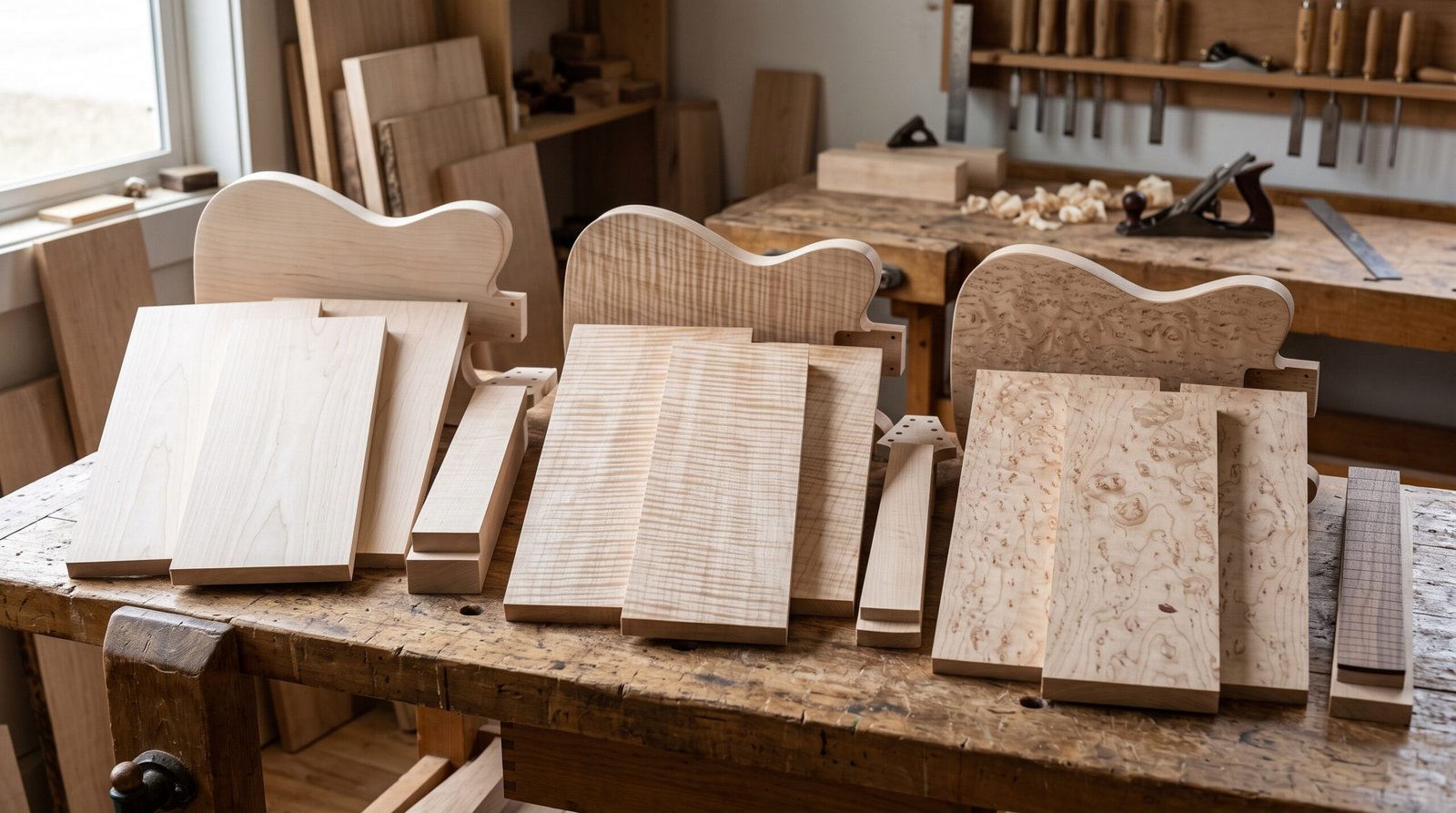
Of all the tonewoods used in guitar making, Maple is probably the most recognizable — and also the one that confuses newcomers the most. Wood labeled “Maple” can look completely different depending on the piece: some pieces ripple with waves of light and shadow, others are covered in tiny dot-like clusters. That’s the difference between Flame Maple and Birdseye Maple — both part of the same Maple family, yet two entirely different “limited editions” of the wood.
This guide breaks down everything you need to know about Maple as a category.
What Is Maple Wood?
Maple grows widely across temperate regions of North America, Europe, and Asia. In guitar building, the two main types used are Hard Maple / Sugar Maple (Acer saccharum) and Soft Maple (typically Red Maple, Acer rubrum). Hard Maple is denser and harder, commonly used for necks and fingerboards, while Soft Maple is somewhat lighter and more often used for bodies and tops.
Plain Maple has a pale yellowish-white color with a fine, even grain — a reliable, understated base wood. But when the fibers twist or develop unusual growth patterns during the tree’s life, it can produce dramatic figure — which is exactly where Flame Maple and Birdseye Maple come from.
Flame Maple: Flowing Light and Shadow
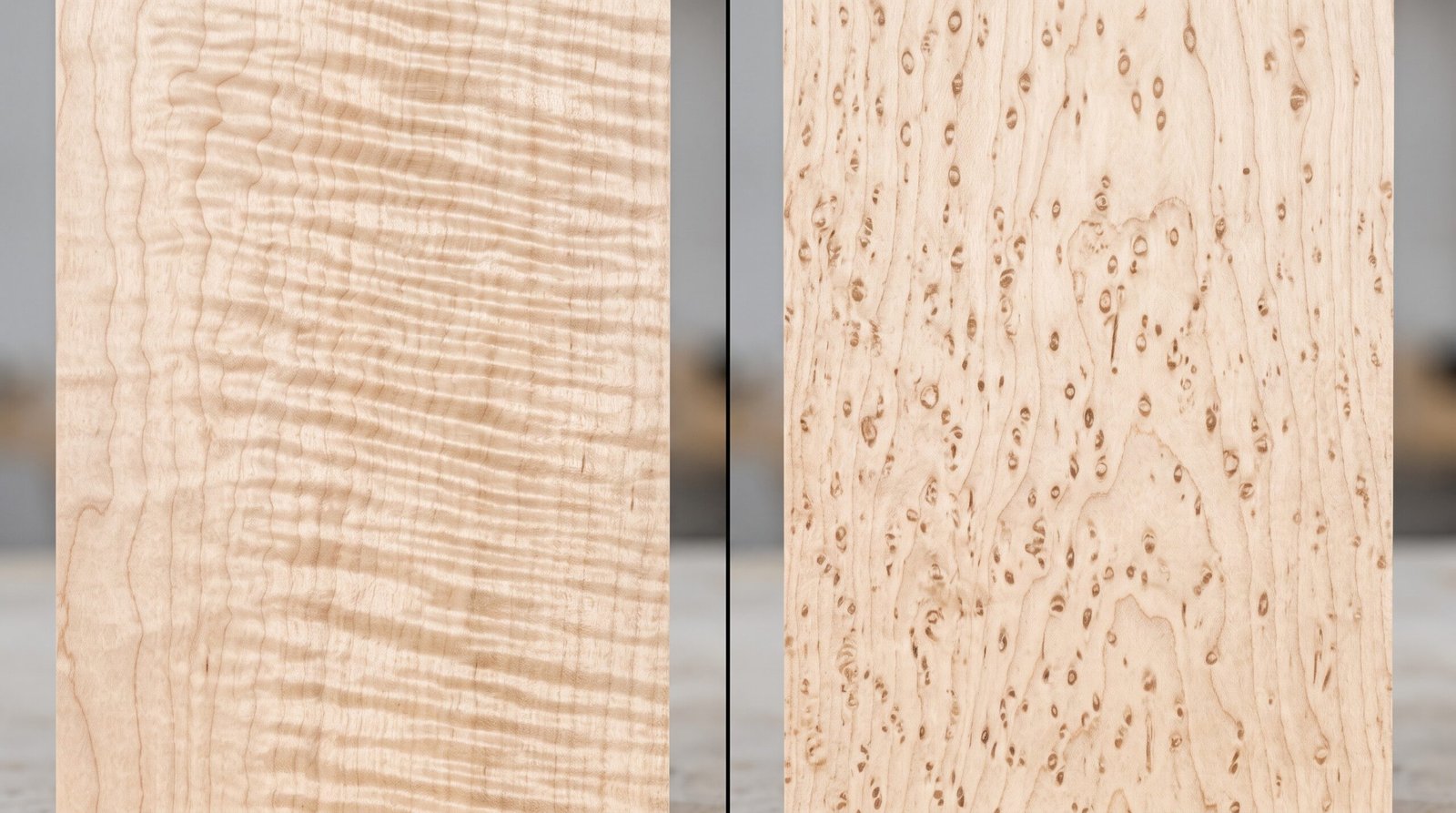
Flame Maple — also known as Tiger Maple or Fiddleback Maple — gets its figure from wavy distortions in the wood fibers as the tree grows. This wave-like structure creates regular bands of light and dark under illumination, and when the wood is turned, those bands appear to “flow” like flames — hence the name.
Flame figure varies enormously in grade, from sparse, low-contrast entry-level pieces to dense, high-contrast, book-matched top-grade “3A” or “5A” stock, with prices differing by several multiples between grades. This is exactly why premium models from brands like Fender and PRS so often feature Flame Maple tops — it’s the most visually direct signal of a “premium” instrument.
Birdseye Maple: A Field of Tiny Eyes
Birdseye Maple’s figure is completely different — it’s covered in dense clusters of tiny circular dots or swirls, resembling countless small eyes embedded in the wood’s surface, hence the name.
The exact cause of Birdseye figure is still debated among experts. The prevailing theory is that it forms from localized fiber distortion when the tree experiences nutrient stress or some other growth pressure — it isn’t unique to a specific species, but rather an occasional occurrence within Hard Maple, which is exactly why it’s relatively rare and commands a premium.
Like Flame Maple, Birdseye figure grade depends on “dot density” — the denser, more evenly distributed, and higher-contrast the dots, the more valuable the piece.
Density and Physical Properties Compared
Both Flame Maple and Birdseye Maple essentially retain the physical properties of their underlying Maple species (usually Hard Maple):
Density: Hard Maple has an air-dry density of roughly 0.63-0.75 g/cm³, placing it in the medium-to-high density range.
Hardness: High Mohs hardness with good wear resistance, making it an ideal choice for fingerboards and necks.
Workability: Because the figure itself results from twisted fiber structure, both Flame and Birdseye Maple are more prone to tear-out during planing or sanding compared to plain Maple, requiring sharper tools and more careful technique — which is also why figured Maple stock generally costs more to process.
Tonal Characteristics
Acoustically, Flame Maple and Birdseye Maple show no meaningful tonal difference from plain Maple — figure is a cosmetic trait, not an acoustic one. Maple’s overall tonal profile is defined by:
Bright, crisp highs: Higher density means faster sound transmission and better high-frequency extension, producing a clear, articulate tone.
Tight low-mids: Unlike the warmth and body of Mahogany or Walnut, Maple’s low-mids are cleaner and more controlled.
Strong attack, clear transients: Well suited to playing styles that demand note clarity and fast response.
This is exactly why Maple is so often used as a top (paired with a Mahogany or Sapele body to balance the tone) and as a neck and fingerboard material (leveraging its hardness and bright tonal character).
Common Applications
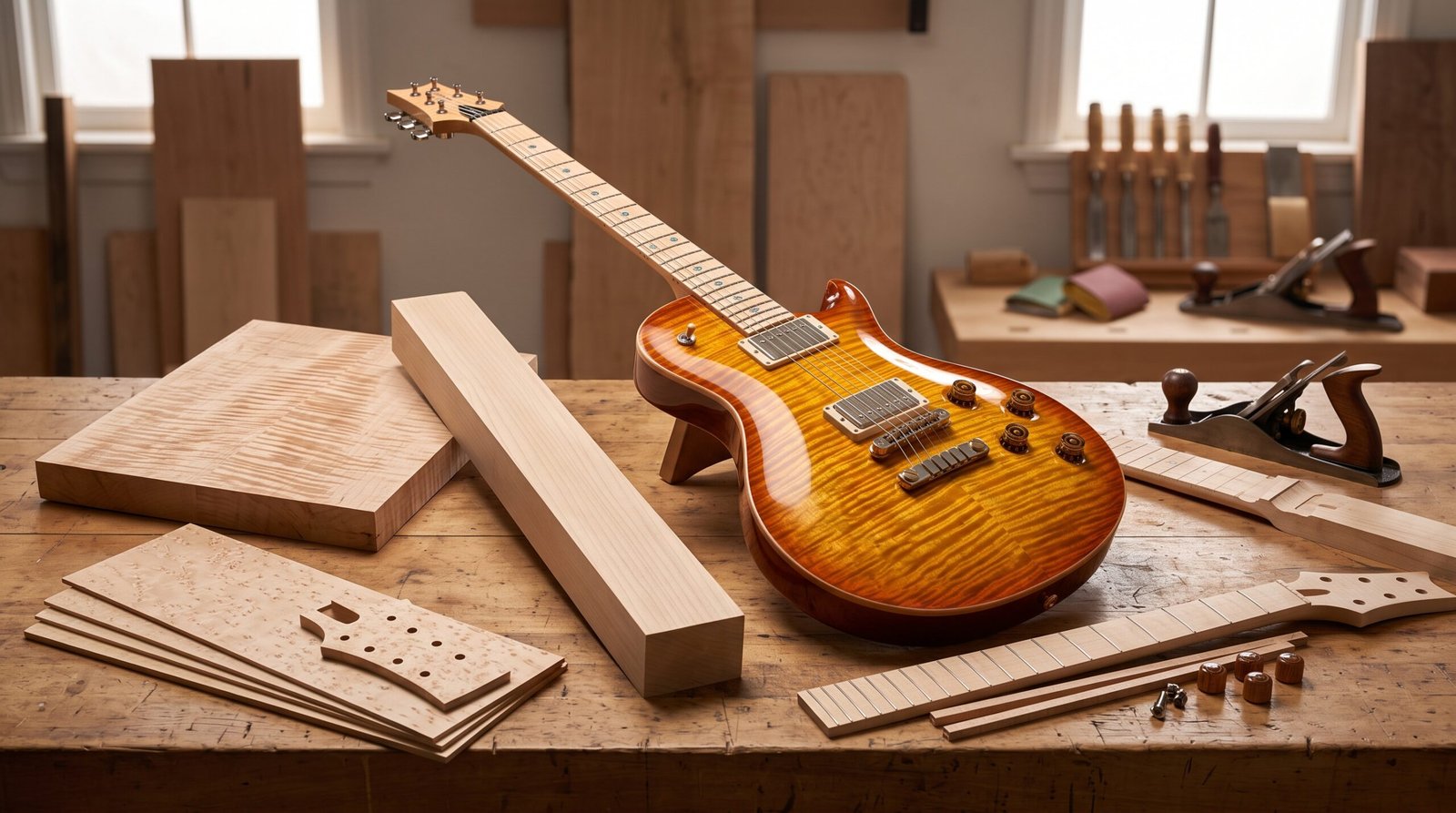
Top Veneer: Flame Maple is one of the most iconic choices for electric and acoustic guitar tops.
Neck: Hard Maple’s hardness and stability make it an industry benchmark for necks.
Fingerboard: Maple fingerboards offer a bright, articulate tone and are the leading alternative to ebony.
Birdseye’s niche uses: Given its dot-like figure works best in smaller display areas, it’s more commonly used for headstock veneers, knobs, and neck-back accents.
Flame Maple vs. Birdseye Maple: Which Should You Choose?
If you want a flowing, dynamic look that fits the traditional “premium instrument” aesthetic, Flame Maple is the safer choice with broader application (works well on both tops and back/sides). If you want something more unique, rarer, and more conversation-worthy, Birdseye Maple is a great way to differentiate — though its dot figure suits smaller display areas, so it’s typically used on fingerboards or localized accents.
Tonally, there’s virtually no difference between the two — the choice mostly comes down to visual preference and application.
Buying Tips
- Confirm the figure grade
For Flame Maple, look at stripe density and contrast; for Birdseye, look at dot density and evenness — price can vary several-fold across grades.
- Check moisture content
Maple’s higher density means poorly controlled moisture content is more likely to cause cracking later on.
- Watch for “artificially stained” fakes
Some sellers dye plain Maple to mimic high-grade Flame figure. Examine the wood under natural light from multiple angles — genuine flame figure reverses light and dark as the angle changes, while dyed figure typically looks flat and static.
- Match density to application
Hard Maple is recommended for necks/fingerboards; Soft Maple can be considered for bodies/tops to reduce overall instrument weight.
Final Thoughts
Maple’s appeal lies in its duality — understated and versatile in its plain form, yet one of the most eye-catching visual centerpieces when figured. Whether it’s the flowing waves of Flame figure or the scattered constellation of Birdseye dots, both are ultimately unique marks left by nature — which is exactly why no two pieces of figured Maple are ever quite the same.
If you’re curious how Maple compares to Black Walnut in body tone, or want to see how Pommele Sapele stacks up against Flame Maple in a head-to-head figure comparison, stay tuned for our upcoming comparison articles.
Maple vs. Black Walnut for Guitar Bodies
Pommele Sapele vs. Flame Maple
Looking for Flame Maple or Birdseye Maple stock for your next build?
Visit our Maple product collection to browse current inventory across grain grades and dimensions.