
The neck is the part of a guitar that carries the most load and demands the most stability. The combined tension of the strings pulls on it constantly, and once the wood moves, even the truss rod may not be able to bring it back. That’s why, among luthiers in North America, Europe, Australia, and East Asia, “stability” almost always ranks ahead of “tone” when choosing a neck wood.
This article focuses on the three most common options: Hard Maple, Roasted Maple, and Sapele. We compare stability, feel, tone, appearance, and price to help you decide which fits your project.
What to Look at First
When choosing neck wood, builders typically weigh these in order:
- Stability: resistance to movement with changes in temperature and humidity
- Stiffness and density: whether it can handle string tension, which also affects sustain and note clarity
- Feel: surface texture, weight, and how it sits in the hand
- Tonal lean: the neck influences overall tone, though usually less than the body and fingerboard
- Appearance and workability: how easy it is to machine, and whether it needs a finish
One more point worth stating: how the board is cut (flatsawn, riftsawn, quartersawn) often matters as much for stability as the choice of species. Quartersawn or near-quartersawn stock is noticeably more stable than ordinary flatsawn stock.
Hard Maple: The Industry Benchmark
Hard Maple (Acer saccharum) is the classic electric guitar neck wood and has been the standard on American electrics since the 1950s.
- Density: air-dry density of roughly 0.63–0.75 g/cm³, hard and stiff
- Stability: properly dried Hard Maple is dimensionally stable, which is the core reason it has held its benchmark position for so long
- Tone: bright, crisp highs, strong attack, good sustain
- Feel: fine, dense texture that works with a gloss finish or a satin or oiled finish, and feels firm once sanded
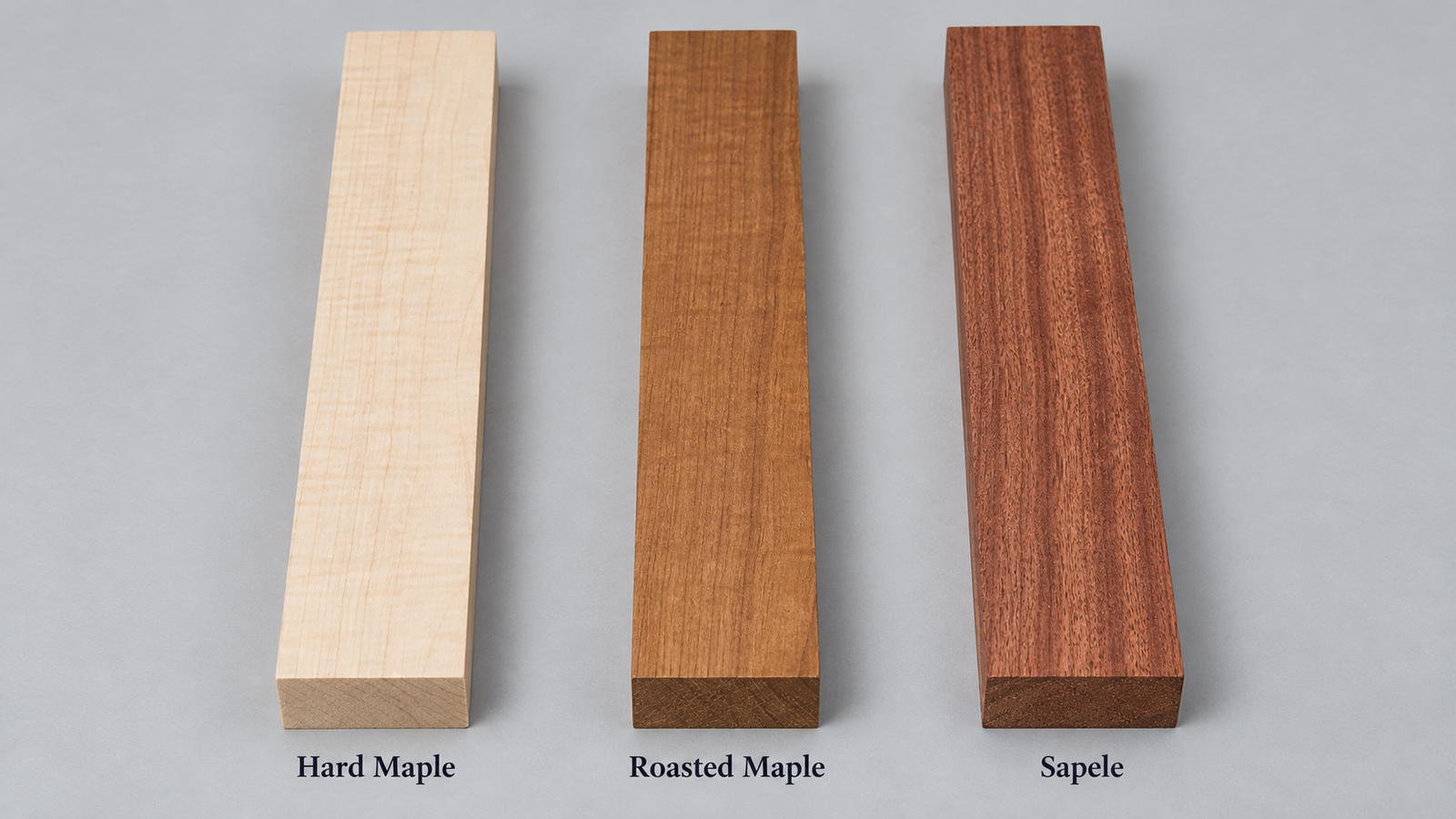
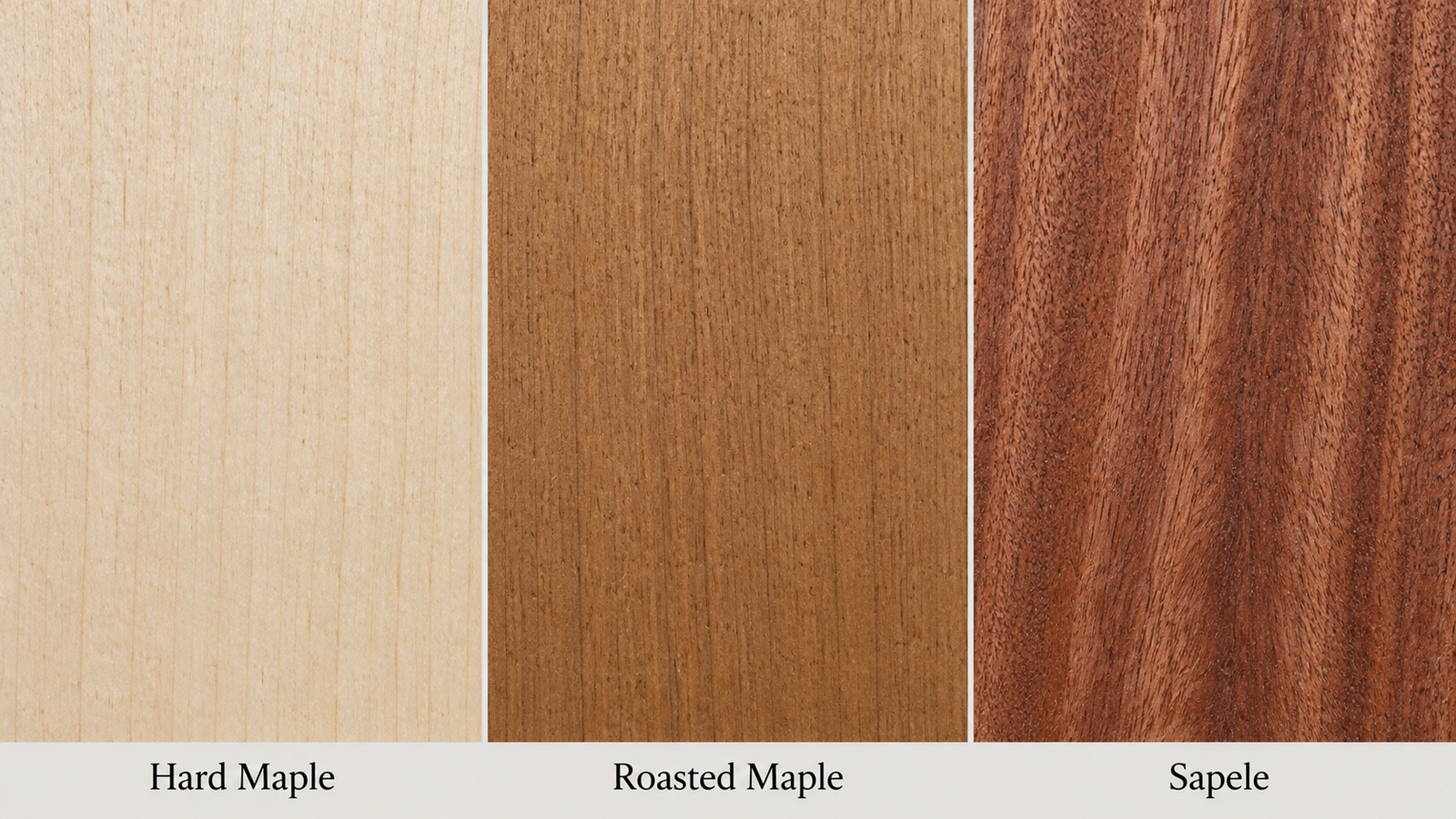
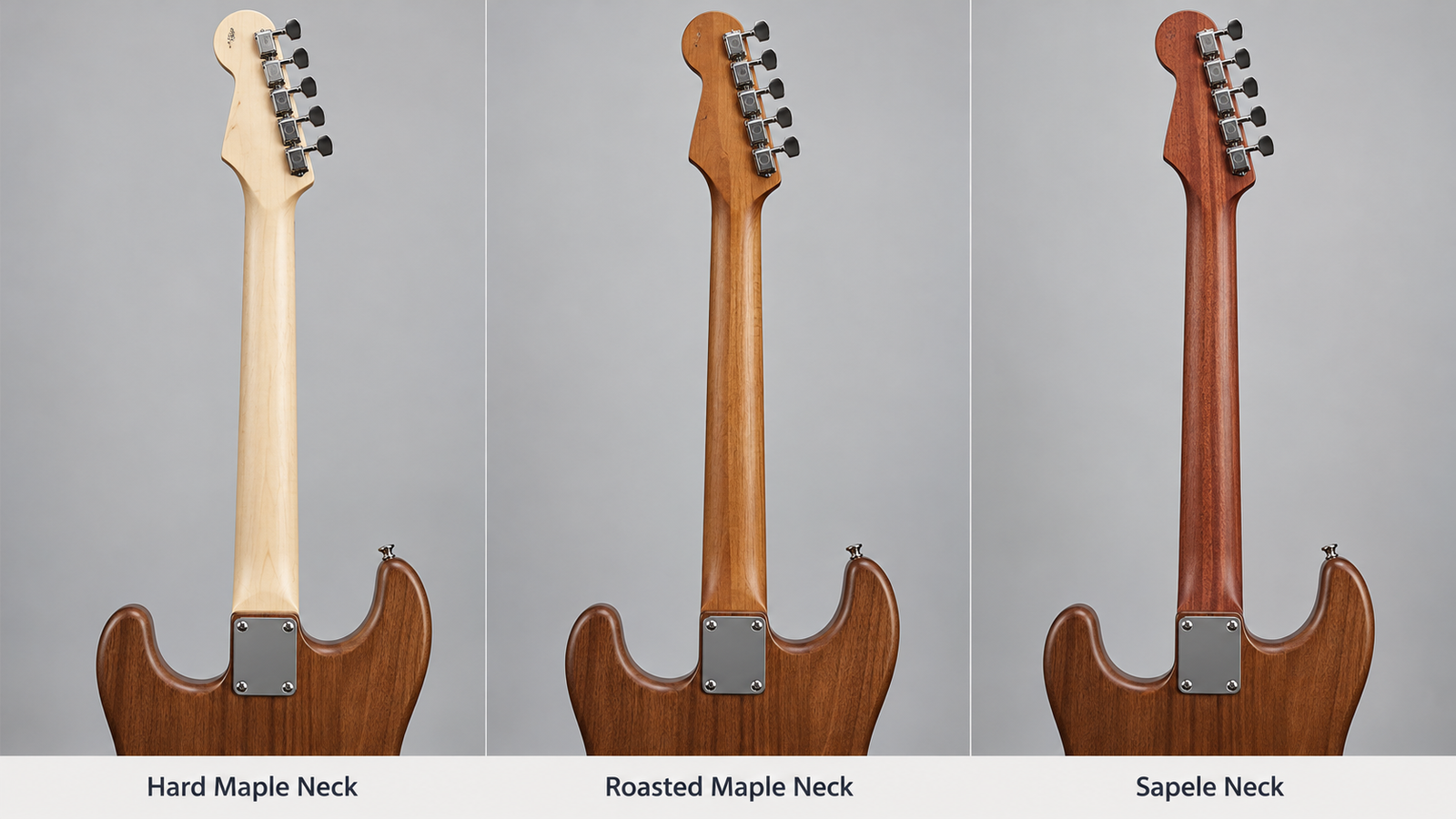
- Appearance: pale yellowish-white and clean-looking, with flame, birdseye, and other figured stock also available
- Watch for: poorly controlled moisture content makes Maple more prone to seasonal movement, so moisture content and storage conditions matter especially for neck blanks shipped to very dry or very humid climates
Roasted Maple: The Stability Upgrade
Roasted Maple (also called Torrefied Maple) is Maple that has been heat-treated in a low-oxygen environment, changing the sugars and hemicellulose in the wood and lowering its moisture content and moisture uptake. In recent years it has become increasingly common among boutique brands in the US and Europe.
- Stability: markedly reduced moisture absorption, so it responds less to temperature and humidity changes, which is its biggest selling point
- Color: ranges from light caramel to dark coffee brown depending on how heavily it is roasted, with a built-in vintage look
- Weight: typically slightly lighter than untreated Maple of the same size
- Tone: many builders report a slightly warmer sound with softer highs than plain Maple, though this is subjective and depends on the degree of roasting
- Feel: a dry, smooth surface that many players like in a bare-wood, thin-finish neck
- Watch for: roasting can make the wood somewhat brittle, so it needs more care when machining than plain Maple, and roasting processes and degrees vary between suppliers, so confirm the treatment before you buy
Sapele: A Stable Alternative to Mahogany
On necks, Sapele plays the role of a good-value alternative to Mahogany, and it is common on both acoustic and some electric guitars.
- Density: air-dry density of roughly 0.62–0.68 g/cm³, slightly heavier than Mahogany, with generally somewhat better hardness and stability
- Stability: performs well overall, and the interlocked grain actually helps reduce the tendency to split
- Tone: solid midrange with a slightly warm lean and a tighter low end, giving a rounder character than a Maple neck
- Feel: medium-hard texture that is comfortable in the hand
- Appearance: reddish-brown with a ribbon-striped sheen from the interlocked grain, which looks good under a clear finish
- Watch for: the interlocked grain is prone to tear-out when planing, so sharp tools are needed, and Sapele necks are usually paired with Maple, Ebony, or Pau Ferro fingerboards, so plan the color pairing in advance
The Three Necks at a Glance
| Dimension | Hard Maple | Roasted Maple | Sapele |
|---|---|---|---|
| Air-Dry Density (approx.) | 0.63–0.75 g/cm³ | Similar to Maple, often slightly lighter | 0.62–0.68 g/cm³ |
| Stability | Good (control moisture content) | Better | Good |
| Tonal Lean | Bright, crisp, strong attack | Slightly warm, softer highs | Solid mids, slightly warm |
| Appearance | Pale yellowish-white, figured stock available | Caramel to dark coffee brown | Reddish-brown, ribbon sheen |
| Machining | Moderate | Somewhat brittle, needs more care | Tear-out risk |
| Price Tier | Mid-range | Higher | Mid-range |
Note: densities are approximate common ranges and vary by batch.
Pairing Ideas: Neck and Fingerboard
- Maple neck + Maple fingerboard: the classic one-piece American style, bright and crisp
- Roasted Maple neck + Roasted Maple fingerboard: a unified vintage tone with the best stability
- Maple or Roasted Maple neck + Pau Ferro or Ebony fingerboard: a bright foundation with a richer fingerboard surface
- Sapele neck + Pau Ferro or Ziricote fingerboard: a warmer overall design for custom builds chasing a smooth tone
Sourcing Tips for International Buyers
- Moisture content: aim for a suitable range (generally 8%–12% for tonewood), and when shipping to continental Europe, dry parts of North America, or humid coastal regions, let the wood acclimate to the local environment before machining
- Cut type: prefer quartersawn or near-quartersawn stock and confirm with your supplier
- Compliance: Sapele is an African species, so sales into the EU (EUDR), the US (Lacey Act), and Australia (Illegal Logging Prohibition Act) call for confirming legal harvest and origin documents, while Maple, as a North American or European wood, generally carries less compliance burden
How to Choose
- Want classic, bright, proven: Hard Maple
- Need maximum stability, or want a vintage look: Roasted Maple
- Want a warmer tone with good value: Sapele
- Shipping to regions with very different climates: lean toward Roasted Maple, ideally quartersawn
Final Thoughts
There’s no one-size-fits-all answer for neck wood, and stability, feel, tone, and budget always involve trade-offs. In most cases, the safest path is to set your stability baseline first (cut type and moisture content), then choose among the three woods by tonal preference and appearance.
For more detail on each wood, read our earlier articles on Sapele and Maple.
Looking for neck stock? Visit our Maple collection and Sapele collection to browse current inventory across dimensions, with worldwide shipping available.