
Choosing body wood is the part of an electric guitar build most likely to get hijacked by tone folklore. Forums are full of lines like “ash is bright, alder is balanced, mahogany is warm.” They sound clear, but they come with plenty of caveats: pickups, neck, fingerboard, strings, amp, and the player all shape the final sound significantly.
So this article doesn’t try to name a winner. Instead, it draws a tone map: common electric guitar body woods placed side by side, with their general tonal lean, weight, and look, to help you narrow your options.

First, How Much Does Body Wood Actually Decide?
Among luthiers in North America, Europe, Australia, and East Asia, a fairly common view is:
- Body wood does affect a solid-body electric, especially its unplugged response, sustain, and overall feel.
- Once plugged in, pickups, electronics, bridge, and neck construction often carry more weight.
- Within one species, density and weight differences between boards can sometimes exceed the differences between species.
So treat the tonal descriptions below as directional guides, not precise predictions.
The Tone Map at a Glance
The table below compares common tonal descriptions, with densities as approximate common air-dry ranges:
| Wood | Air-Dry Density (approx.) | Tonal Lean | Weight Impression | Appearance |
|---|---|---|---|---|
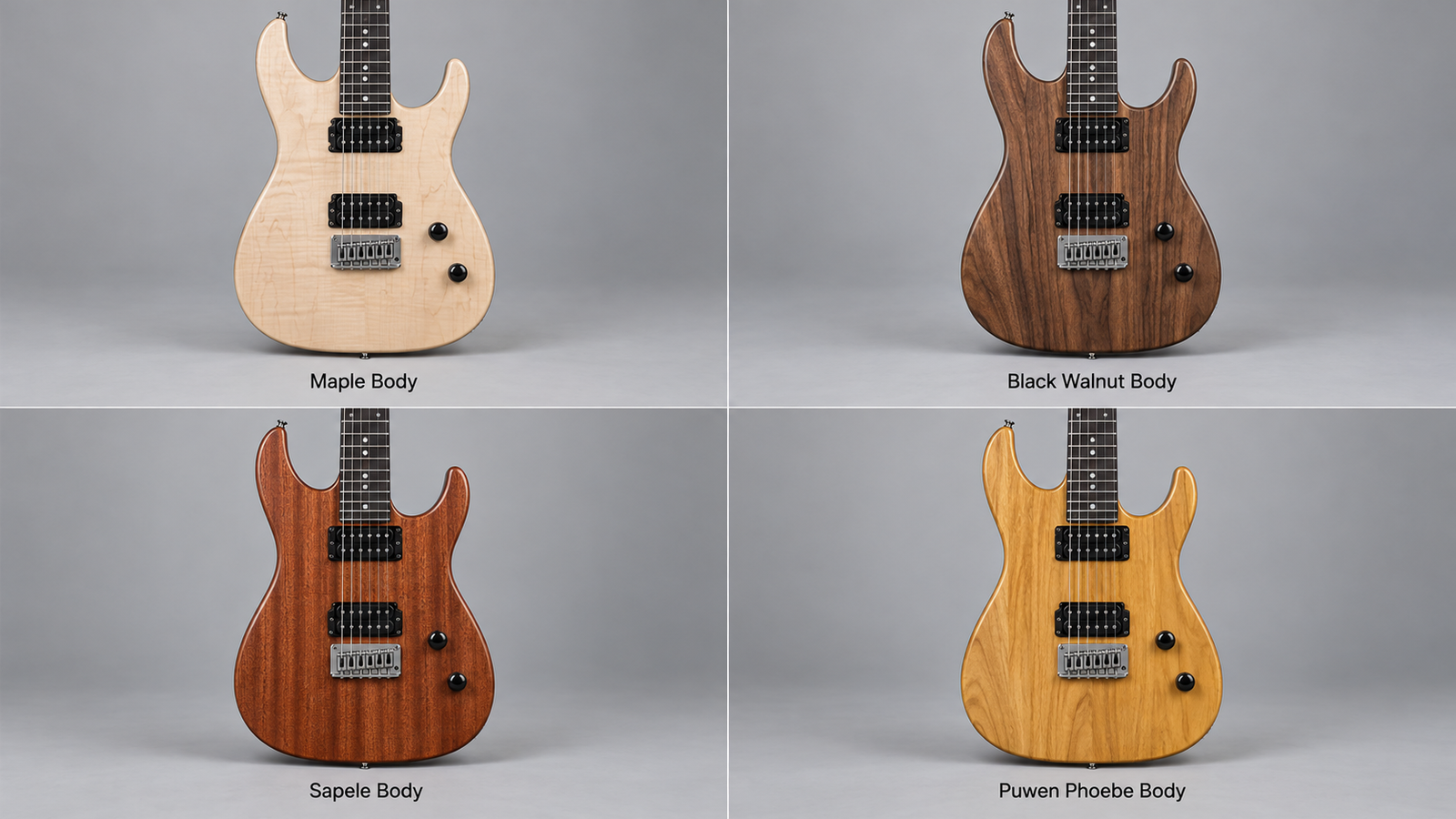
| Maple | 0.63–0.75 g/cm³ | Bright, crisp, strong attack | Heavier | Pale, with flame and birdseye figure available |
| Ash (incl. lightweight swamp ash) | Varies by type and selection; lightweight swamp ash is noticeably lighter | Bright and open, clear mids, full lows | Lightweight stock can be very light | Open grain, pronounced pattern under clear finish |
| Sapele | 0.62–0.68 g/cm³ | Solid mids, slightly warm, tight lows | Medium to heavy | Reddish-brown, ribbon sheen, pommele stock is striking |
| Puwen Phoebe | 0.5–0.6 g/cm³ | Balanced, smooth, soft highs | Medium to light | Golden color, silky sheen |
| Black Walnut | 0.55–0.64 g/cm³ | Full, warm mids, controlled lows, soft highs | Medium | Deep chocolate brown, understated |
| Alder | ~0.4–0.5 g/cm³ | Balanced, slightly forward mids | Light to medium | Pale, subtle grain, often used under opaque or burst finishes |
| Basswood | ~0.37–0.45 g/cm³ | Forward mids, overall rounded | Light | Pale, even grain, common under opaque finishes |
Note: density ranges are approximations commonly cited in the industry and vary by batch, origin, and moisture content. “Tonal lean” reflects common luthier descriptions and includes a subjective element.
One by One: What Each Wood Suits
Maple: Brightness and Clarity
Maple is dense and stiff, with fast sound transmission. Most builders describe it as bright in the highs, crisp in attack, and quick in response, suited to metal, progressive rock, country, and other styles that need clear articulation.
One caveat: an all-Maple body is usually heavy, which matters for long standing sets. That’s why many designs use Maple on the top or neck and a lighter wood for the main body.
Black Walnut: The Warm, Full “Middle Ground”
Black Walnut is less dense than Maple, and its tone is often described as sitting between Maple and Mahogany: full, warm mids, controlled lows, and soft, non-harsh highs. It machines well, is reasonably stable, and its dark color has natural presence, which has helped its popularity in the boutique custom market recently. It suits blues, jazz, pop, and styles that call for warm thickness.
Sapele: A Solid-Mids Mahogany Alternative
On electric bodies, Sapele works as a good-value alternative to Mahogany, with solid mids, a slightly warm lean, and a tighter low end than Mahogany. Pommele Sapele is often used as a top veneer, adding visual impact to custom builds.
Puwen Phoebe: Light, Soft, Distinctive
Puwen Phoebe is a medium-to-light wood with a balanced, smooth tone and soft highs, and its defining feature is a golden color with a silky sheen. It suits custom projects that want a distinctive look together with a friendly weight. Supply is relatively limited, making it a niche choice for custom builds.
Ash, Alder, Basswood: Reference Baselines
These three are the “classic baselines” of electric guitar bodies, used very widely across North America and useful for understanding the woods above:
- Ash: open grain, bright highs, clear mids, full lows, with lightweight swamp ash prized for its low weight.
- Alder: balanced tone with slightly forward mids, a staple of classic American electric bodies.
- Basswood: forward mids with a rounded overall character, affordably priced, common on models with opaque finishes.

Common Pairing Ideas
Body wood rarely decides the sound alone. Some common combination ideas:
- Maple top + lighter body (e.g., Alder, Puwen Phoebe): Maple’s figure and appearance, with controlled overall weight.
- Pommele Sapele top + Black Walnut or Sapele body: a strong visual focal point over a naturally darker body wood.
- Black Walnut body + Maple neck + Pau Ferro fingerboard: a common combination for builders seeking a balance of appearance, feel, and response.
- All-Maple body: for projects exploring Maple’s stiffness and response that can accept the extra weight.
The thickness of a top matters: a thin decorative veneer should primarily be chosen for its appearance, rather than an expected tonal change.
Four Questions to Ask Before Choosing
- What style will you mainly play? Use the common tonal descriptions to set an initial direction, then consider pickups, hardware, and construction alongside the wood.
- How heavy a body can you accept? If weight matters, compare the actual blanks. Lightweight Ash, Alder, Basswood, and selected Puwen Phoebe stock are options worth considering.
- What look do you want? Under a clear finish, Maple, Sapele, Puwen Phoebe, and Black Walnut show their grain, while under opaque finishes the look matters little.
- What does your target market require for compliance? Confirm the applicable timber sourcing and import requirements for your destination market. Keep accurate species, origin, and legal sourcing records for both domestic and imported woods.
Final Thoughts
A tone map is a tool, not a verdict. A more reliable approach is to use the map to set a rough direction, then decide on combinations with pickups, neck, fingerboard, and your budget in mind. If you can, listen to real instruments built from similar woods, since that is more persuasive than any adjective.
To learn more about each wood, read our articles on Maple, Black Walnut, Sapele, and Puwen Phoebe, along with our Maple vs. Black Walnut Body comparison.
Looking for body stock? Visit our Maple collection, Black Walnut collection, Sapele collection, and Puwen Phoebe collection to browse current inventory across dimensions, with worldwide shipping available.