
The fingerboard is the part of a guitar your hand touches most. It is also one of the most popular upgrades on a custom build—and one of the most debated. Across boutique guitar markets in North America, Europe, Australia, and East Asia, buyers face a long list of candidates: classic Ebony, Pau Ferro, the lesser-known African Congo Rosewood, and the figured options, Ziricote and Pale Moon Ebony.
This article puts all five side by side and compares density, feel, tone, appearance, compliance, and price, so you can narrow down your choice faster.
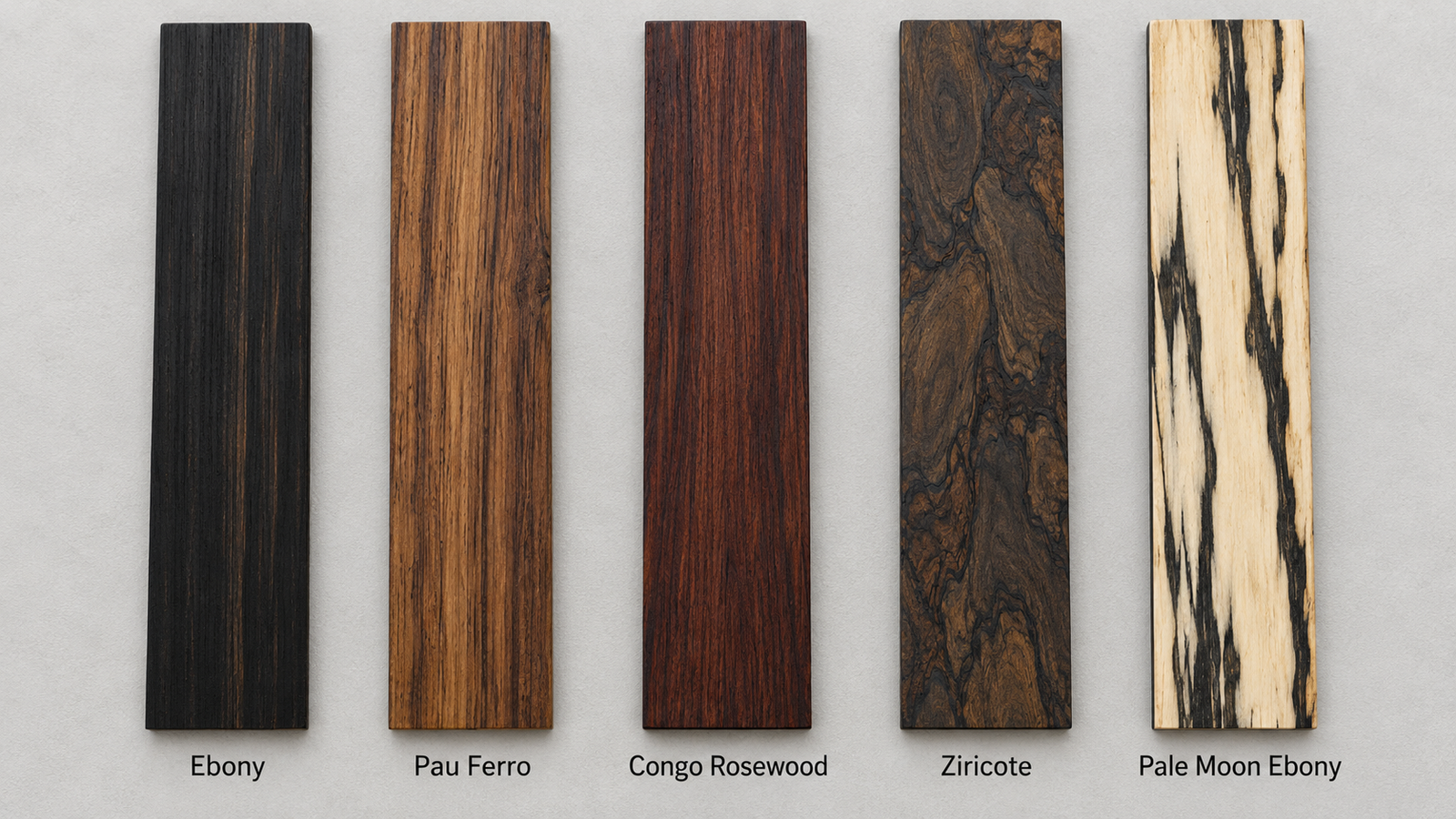
All Five at a Glance
| Dimension | Ebony | Pau Ferro | Congo Rosewood | Ziricote | Pale Moon Ebony |
|---|---|---|---|---|---|
| Botanical Name | Genus Diospyros | Machaerium scleroxylon | Dialium spp. | Cordia dodecandra | Genus Diospyros (Sulawesi Ebony variant) |
| Primary Origin | Africa, Madagascar | Bolivia, Brazil | Congo Basin, Central Africa | Yucatán, Central America | Indonesia |
| Air-Dry Density (approx.) | 0.95–1.2 g/cm³ | 0.75–0.85 g/cm³ | 0.9–1.0 g/cm³ | 0.75–0.80 g/cm³ | 0.9–1.1 g/cm³ |
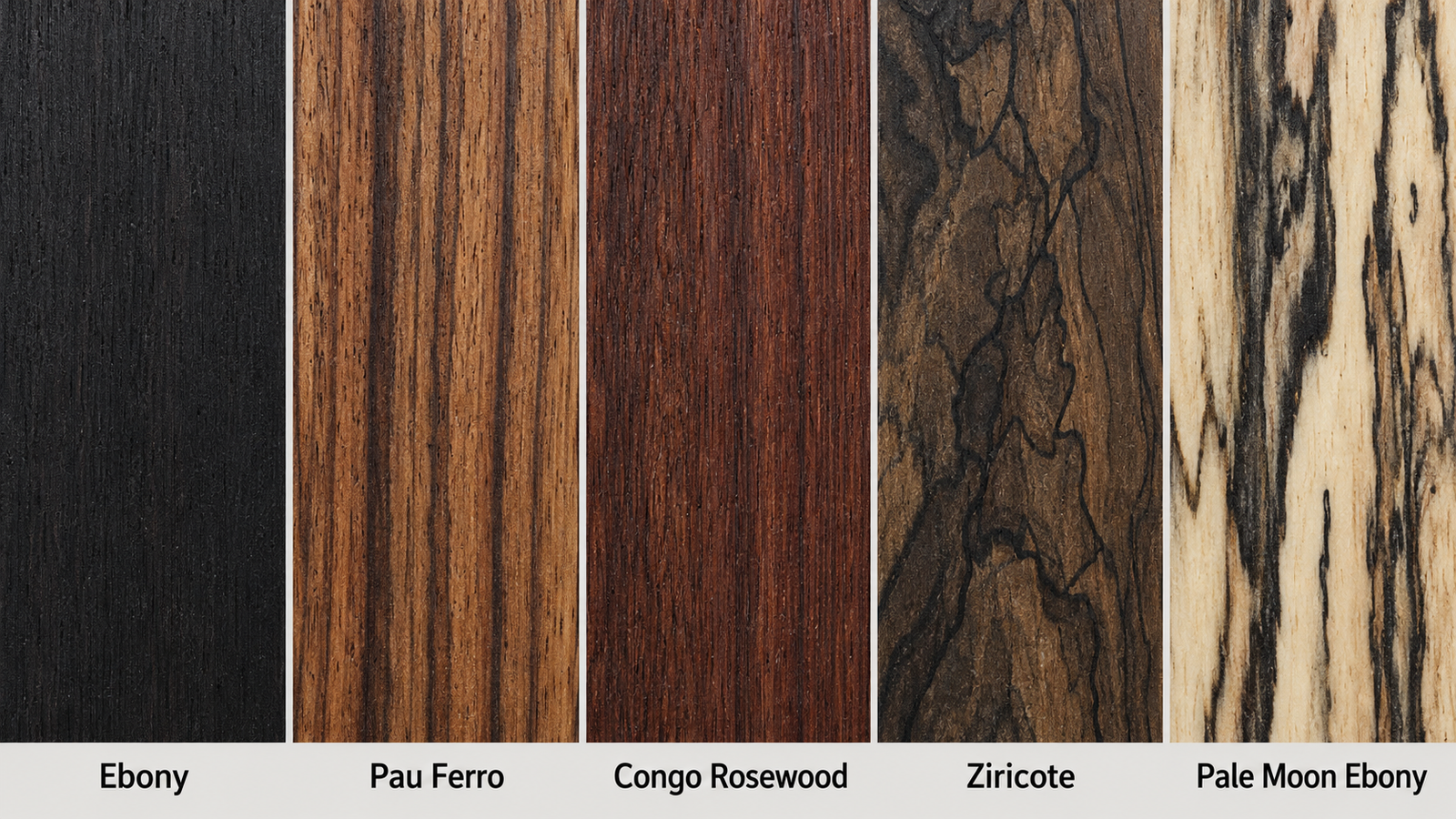
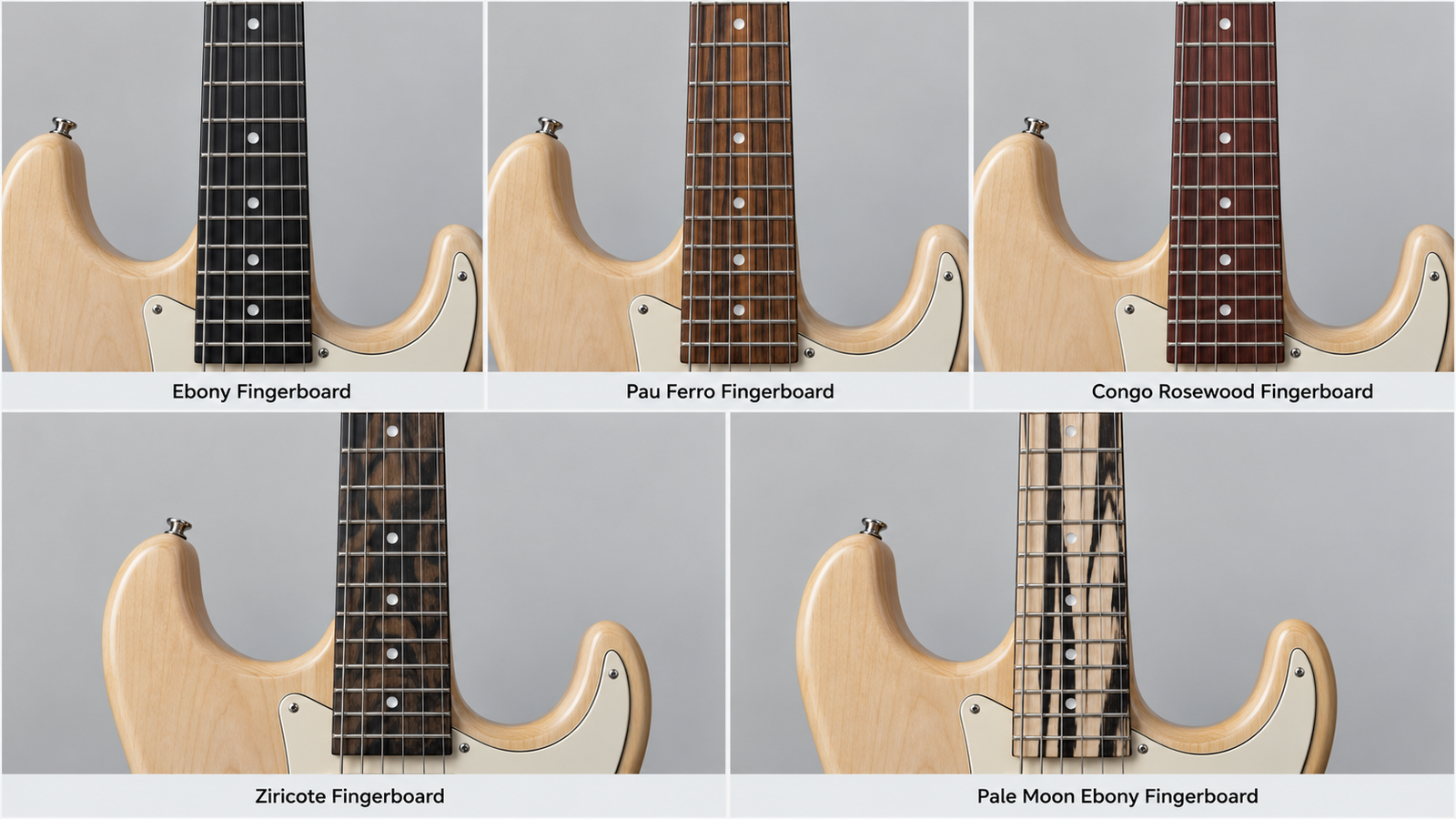
| Appearance | Solid black, almost no visible grain | Light to deep purplish-brown, streaked | Deep red-brown to purplish-brown, fine grain | Spiderweb figure on deep brown-to-black | Bold black-and-white mottling |
| Tonal Lean | Bright, crisp, strong attack | Between Ebony and Rosewood | Solid, weighty low-mids | Clear with a touch of warmth | Close to Ebony, bright and crisp |
| Oil Content | Low | Higher | Moderate | Moderate | Low |
| Compliance Difficulty | Higher (most Ebony is CITES-regulated) | Lower (removed from regulation) | Origin documents need close checking | Confirm origin and legal harvest documents | Ebony family, typically stricter scrutiny |
Note: densities are approximate common ranges and vary by origin and batch.
Density and Feel
Ebony and Pale Moon Ebony are the densest, followed by Congo Rosewood, with Ziricote and Pau Ferro somewhat lower. All five are high-density hardwoods, and their wear resistance is more than sufficient for fingerboard use.
Differences in feel come more from surface texture and oil content:
- Ebony and Pale Moon Ebony: Extremely dense, smooth, and cool to the touch, developing a warm polish with long use.
- Pau Ferro: Higher oil content, so a new instrument can feel slightly “oily,” which some players find makes bending smoother.
- Congo Rosewood: Fine, firm texture that feels tight once sanded.
- Ziricote: Naturally oily, with good moisture resistance and a smooth surface, well suited to humid regions.
Tonal Lean
A fingerboard’s influence on tone is often both underestimated and overstated. Results depend on the whole build, but among luthiers there is a rough consensus:
- Ebony and Pale Moon Ebony: Crisp highs, strong attack, and excellent sustain, suited to modern metal, progressive music, and other styles that call for maximum clarity.
- Pau Ferro: Clear but softer highs with a slightly more solid midrange—a balanced all-rounder.
- Congo Rosewood: Heavier low-mids, suited to styles that need solid low-end support.
- Ziricote: Clarity with a touch of warmth, often seen on fingerstyle and high-end acoustic guitars.
Most players struggle to tell adjacent woods apart in blind tests, so treat tone as a guide rather than the deciding factor.
Appearance: The Most Visible Decision Factor
- Want minimalist solid black? Ebony is the classic choice.
- Want a natural, layered deep brown? Consider Pau Ferro or Congo Rosewood.
- Want understated, artistic figure? Choose Ziricote for its ink-wash spiderweb patterns.
- Want a bold, dramatic focal point? Pale Moon Ebony offers high-contrast black and white.
Compliance and Supply: The Part International Buyers Can’t Skip
For sourcing or distribution into the EU, US, or Australia, compliance often decides whether you can buy at all, before tone ever enters the picture:
- Ebony: Most species are listed under CITES Appendix II, which makes cross-border shipments more involved.
- Pau Ferro: Briefly regulated in the past, removed from regulation after 2019, so sourcing is comparatively straightforward.
- Congo Rosewood: African timber, where legal harvest and origin documentation are the focus of scrutiny.
- Ziricote: Concentrated supply and relative rarity, so confirm origin and legal harvest documentation.
- Pale Moon Ebony: Ebony family wood, typically subject to stricter compliance review.
Regulations change over time. Rely on the latest requirements under EU EUDR, the US Lacey Act, Australia’s Illegal Logging Prohibition Act, and CITES, and confirm full documentation with your supplier before purchasing.
Rough Price Tiers
Price varies widely with figure grade, board size, and batch, so these are relative tiers only:
- More accessible: Pau Ferro, with stable supply.
- Mid-range: Congo Rosewood and plain-figure Ziricote.
- Higher: Top-quality solid black Ebony, plus high-grade figured Ziricote and Pale Moon Ebony—especially unique or symmetrical collector-grade boards.
How to Choose: Quick Matching by Need
- Limited budget, want a safe choice with easy compliance: Pau Ferro.
- Want classic solid black and maximum clarity, with budget to spare: Ebony.
- Want a story-rich rare African wood with weighty low-mids: Congo Rosewood.
- Want an artistic figure for a matched visual set: Ziricote.
- Want an instantly recognizable, high-personality fingerboard: Pale Moon Ebony.
Final Thoughts
No single fingerboard wood is “the best.” The right choice is the one that fits your budget, aesthetic, and target market.
If you are a luthier or brand owner, start by narrowing the field based on your target market’s compliance requirements. Then weigh appearance and tone against your product positioning.
To explore any of these woods further, read our individual species articles and our comparison pieces, Ebony vs. Pau Ferro and Ziricote vs. Pale Moon Ebony.
Looking for fingerboard stock? Visit our fingerboard wood collection to browse current inventory across figure grades and dimensions, with worldwide shipping available.