
In the boutique guitar markets of the US and Europe, most buyers don’t know much about Asian-sourced tonewoods — beyond old familiars like Rosewood and Ebony, few could name a third. But spend time in an independent luthier workshop on the American West Coast, or flip through the material specs of a premium Japanese acoustic brand, and you’ll likely run into a name: Burmese Yellow Heart Nanmu. Its golden-yellow color, refined luster, and status as a rare Southeast Asian material have quietly turned it into something of a hidden gem among Western luthiers in recent years.
This guide introduces this understated but highly distinctive tonewood.
What Is Yellow Heart Nanmu?
Yellow Heart Nanmu belongs to the Nanmu group within the Lauraceae (laurel) family, native primarily to the mountainous tropical and subtropical forests of northern Myanmar and surrounding regions. Historically, this category of trees has been used locally in Southeast Asia for construction, furniture, and carving, and it’s only in recent years been discovered by the American, European, and Japanese instrument-making industries as an emerging material with both visual and tonal appeal.
Because Nanmu-family species have long remained a niche category within the international tonewood trade, current supply of Yellow Heart Nanmu is relatively limited — one reason its price has been climbing steadily in US and European boutique markets, with more and more custom shops listing it as a “limited availability” material option.

Appearance and Grain Characteristics
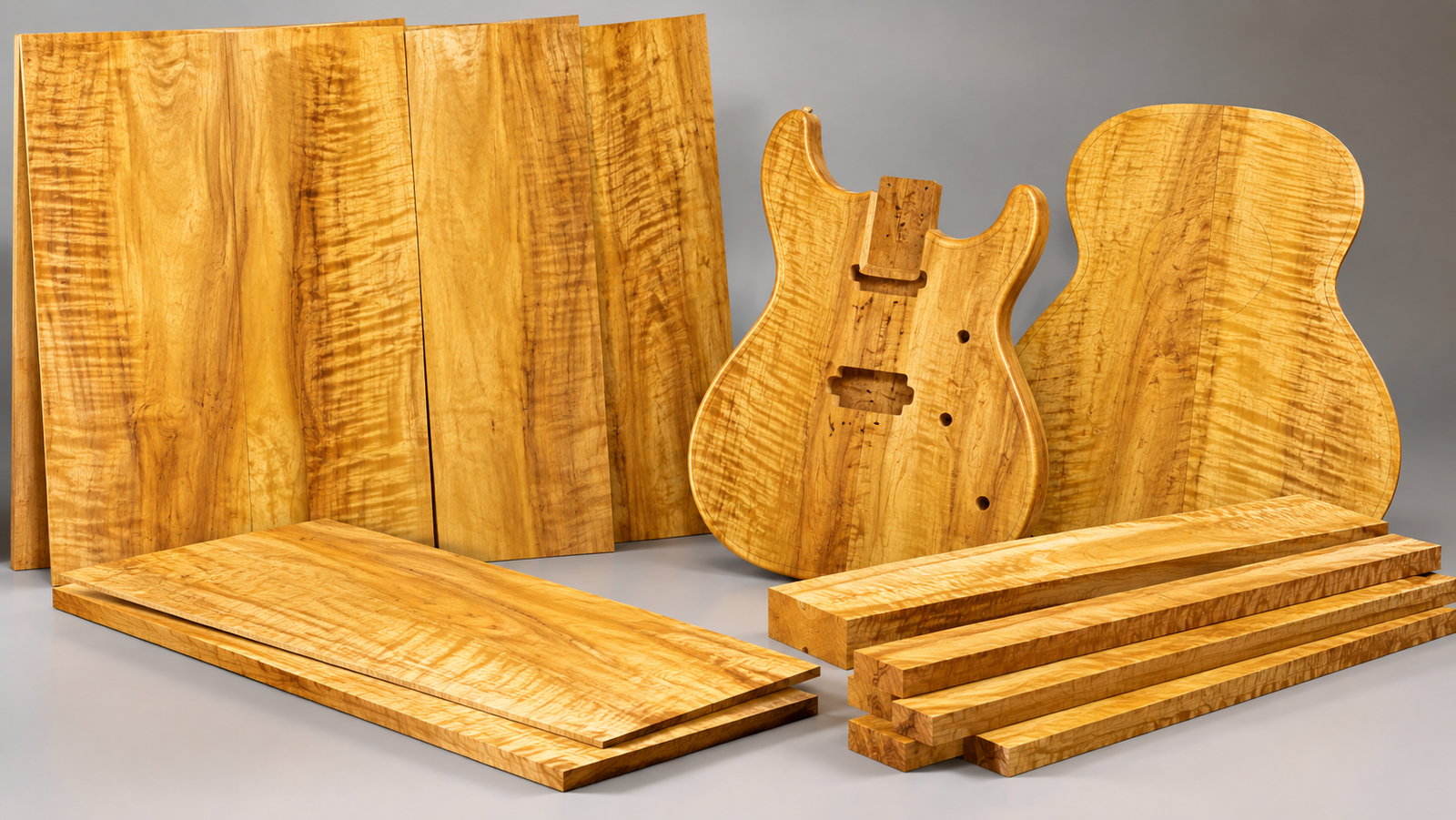
Yellow Heart Nanmu’s most immediately striking feature is its golden-yellow to honey-toned heartwood, with a fine, even texture and a naturally soft, silky sheen — turning the wood under light reveals a satin-like reflective quality that leaves a strong first impression on most Western buyers seeing it for the first time. Compared to Maple’s cool white tones or Walnut’s deep brown, Yellow Heart Nanmu’s warm golden hue is a relatively rare option visually, often chosen to give a custom build a distinctive, standout look.
The grain is generally straight, with some boards showing subtle wavy light effects — a hint of “faint flame figure” — though not as pronounced or regular as Maple’s classic flame pattern.
Density and Physical Properties
Yellow Heart Nanmu has an air-dry density of roughly 0.5-0.6 g/cm³, placing it in the light-to-medium weight range — a real advantage for weight-conscious builds. This matters particularly for lightweight electric guitar body designs, and quite a few boutique brands in the US and Australia list Yellow Heart Nanmu as a candidate material when building “lightweight custom” models.
Its overall workability is good — the straight grain makes it easy to plane and sand, with little tendency toward tear-out, making it a material widely regarded by luthiers as easy to work with.
Tonal Characteristics
Acoustically, Yellow Heart Nanmu’s tone sits somewhere between Maple and Mahogany:
- Warm, full midrange: Its moderate density delivers solid but not overly heavy midrange body
- Smooth, lustrous highs: Unlike Maple’s sharp brightness, Yellow Heart Nanmu’s highs are rounder, with a certain “silky” quality
- Well-balanced overall response: No single frequency range stands out excessively, giving it a versatile, easy-to-like tonal character
This balanced, warm tonal profile, combined with its distinctive golden appearance, has gradually earned Yellow Heart Nanmu a place in both American boutique acoustic building and high-end Japanese custom electric guitars — particularly favored by buyers who appreciate a material that’s rare but still easy on the ears.
Common Applications
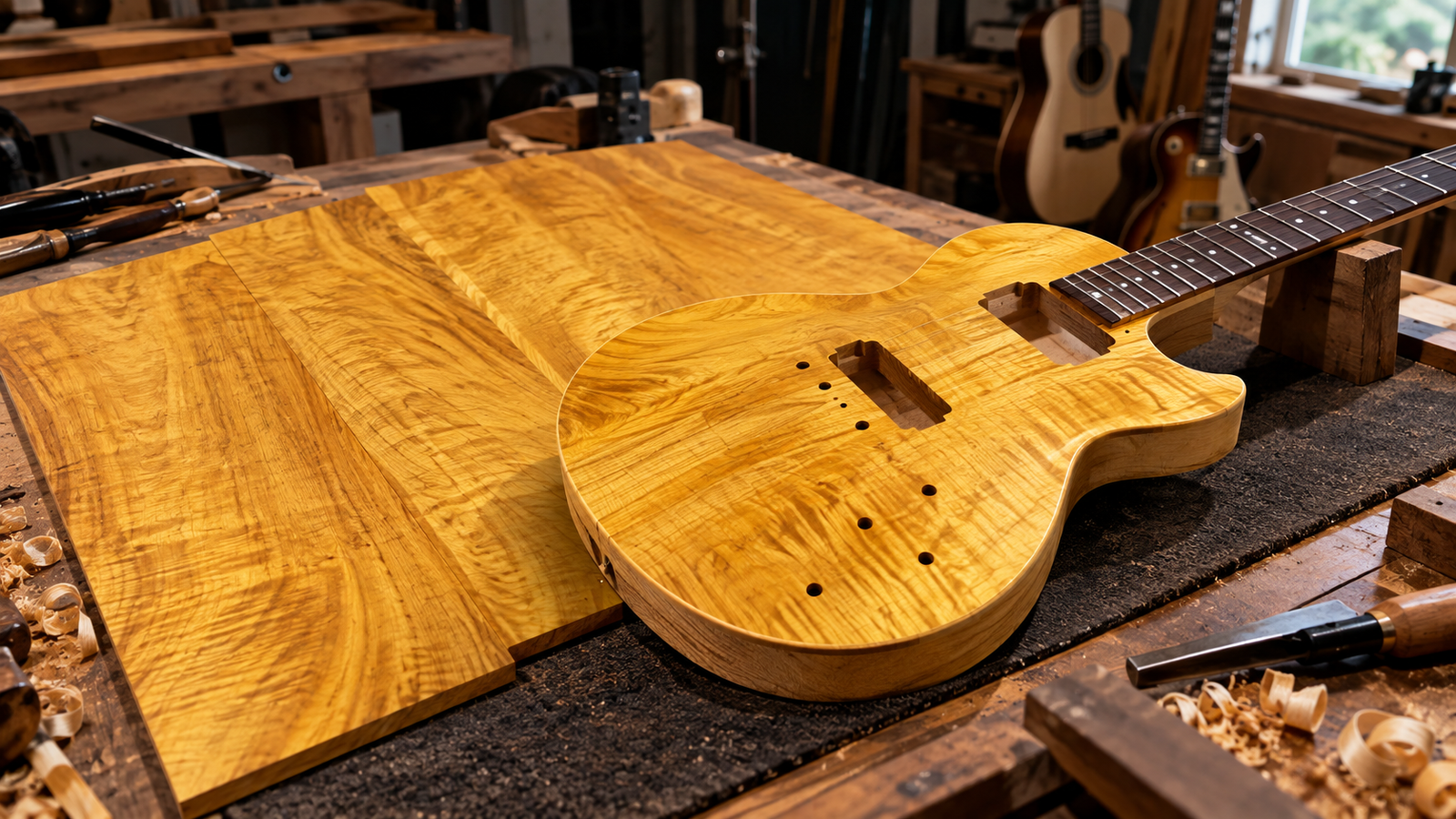
- Body: Yellow Heart Nanmu’s moderate density and balanced tone make it an excellent choice for electric guitar bodies, especially in lightweight-focused designs
- Top: Some acoustic builders use Yellow Heart Nanmu for tops, leveraging its distinctive golden luster for a differentiated look
- Back & Sides: A small number of high-end custom builds use it for back/side sets, paired with a Maple or Walnut top for contrast
- Decorative Veneer: Given its distinctive tone, it’s also used for headstock veneers and pickup covers as small-area accents
Buying Tips
For international buyers, keep an eye on the following when selecting Yellow Heart Nanmu stock:
- Color consistency of the heartwood — quality Yellow Heart Nanmu should show even, consistent color; excessive color variation or mottling can affect the overall visual appeal
- Moisture content — tonewood should generally be kept between 8%-12%, with extra attention needed when shipping to drier climates like Europe or North America
- Cracks or insect damage — given its concentrated sourcing region and limited supply, it’s worth inspecting boards carefully to avoid waste from defects
- Origin and legal harvest documentation — for sales or sourcing into the EU (EUDR), the US (Lacey Act), or Australia (Illegal Logging Prohibition Act), it’s worth confirming legal harvest origin and import compliance documentation with your supplier
Final Thoughts
Yellow Heart Nanmu’s gradual rise in the boutique guitar circles of the US, Europe, and Japan isn’t driven by novelty for its own sake — it’s earned through genuinely solid performance on both the visual and tonal fronts: a golden color that’s instantly recognizable, paired with a tone that’s easy to live with across styles. If you’re sourcing material for a custom build that needs to be distinctive without being a gamble, Burmese Yellow Heart Nanmu absolutely deserves serious consideration.
If you’re curious how Yellow Heart Nanmu compares to Maple and Walnut in real tonal terms, stay tuned for our upcoming comparison article.
Looking for Burmese Yellow Heart Nanmu stock for your next build? Visit our Yellow Heart Nanmu product collection to browse current inventory across dimensions and grades — with worldwide shipping available.