
In the tonewood trade, the term “African Rosewood” is sometimes used loosely to describe several different African hardwoods. Congo Rosewood (Dialium spp.) is one such material that has attracted interest among guitar makers looking for distinctive alternatives to more familiar tonewoods.
With its deep reddish-brown color, potentially high density, and origins in tropical Africa, Congo Rosewood offers an intriguing combination of appearance and material characteristics. However, its exact properties depend on the species, growing conditions, and quality of the individual boards.
This guide explores Congo Rosewood, its appearance, physical properties, potential tonal characteristics, common applications, and sourcing considerations for guitar makers and tonewood buyers.
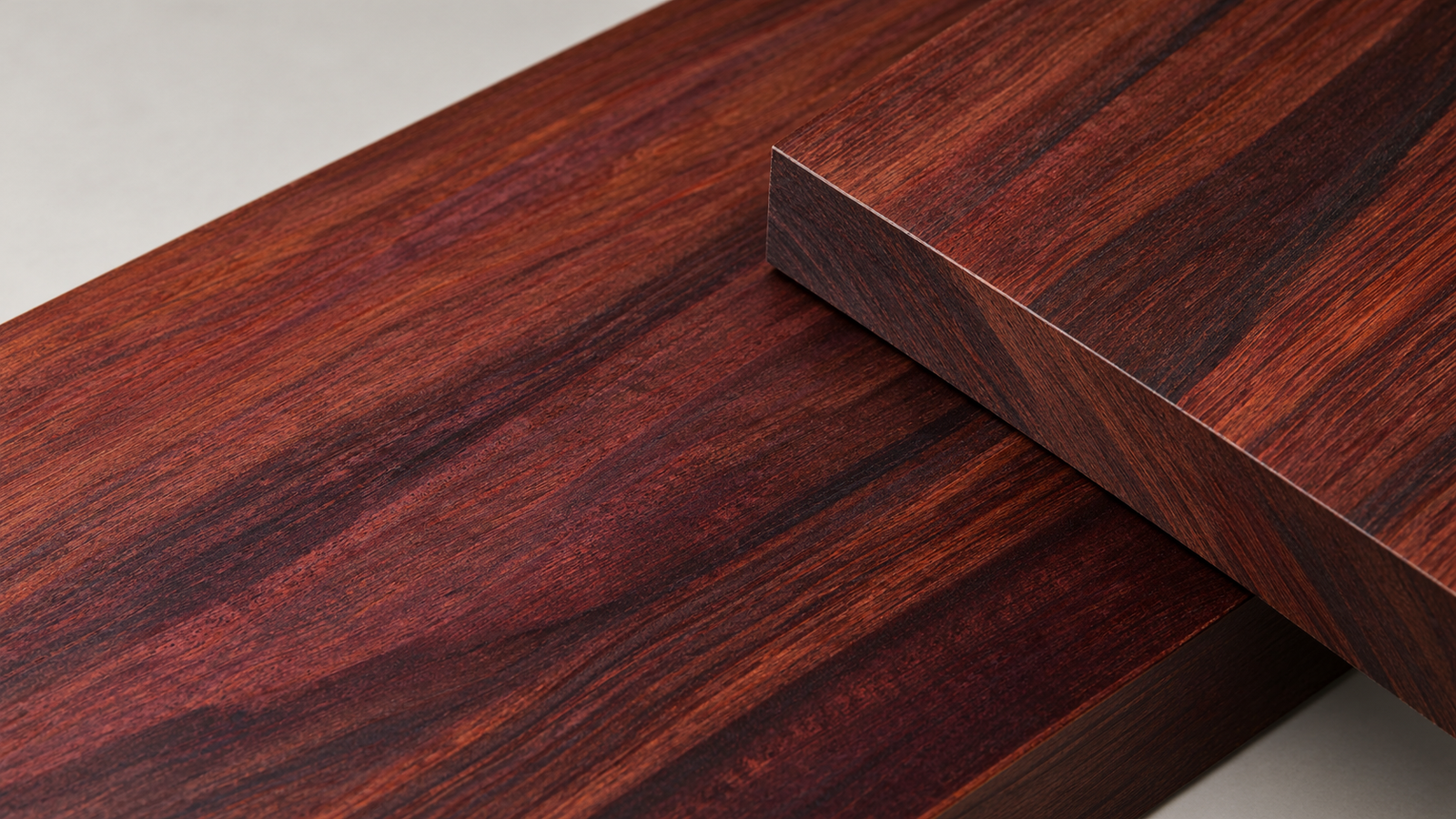
What Is Congo Rosewood?
Congo Rosewood is a trade name associated with certain hardwoods in the genus Dialium, which belongs to the Fabaceae family. Species within this genus occur in tropical regions of Africa, including parts of West and Central Africa.
The name “Congo Rosewood” is not a standardized botanical name. Different suppliers may use different commercial names for Dialium species, and the exact species should be confirmed whenever possible.
It is also important to distinguish Congo Rosewood from true Rosewood, which belongs to the genus Dalbergia. Despite the similar trade names, these are botanically different groups of trees.
The wood of Dialium species has traditionally been used for various purposes in its native regions, including construction and other timber applications. Its potential use in musical instruments depends on the properties of the particular species and the quality of the material available.
For guitar makers, understanding the exact species and origin is an important first step when evaluating this relatively specialized tonewood.
Explore Other Guitar Tonewoods
Appearance and Grain Characteristics
Congo Rosewood is generally described as having heartwood that ranges from deep reddish-brown to purplish-brown. Depending on the species and individual board, the grain may appear relatively straight and fine, with subtle variations in color and texture.
Its darker reddish-brown appearance can provide an attractive alternative to more familiar guitar woods. Compared with the varied colors and grain patterns commonly associated with true Rosewood, some Congo Rosewood boards may offer a more restrained and understated visual character.
However, natural variation is important. Color, grain, and figure can differ considerably between individual boards, so buyers should evaluate actual product photographs rather than relying on the trade name alone.
Like many hardwoods, Congo Rosewood may also change in appearance over time as it is exposed to light and its surface finish ages.
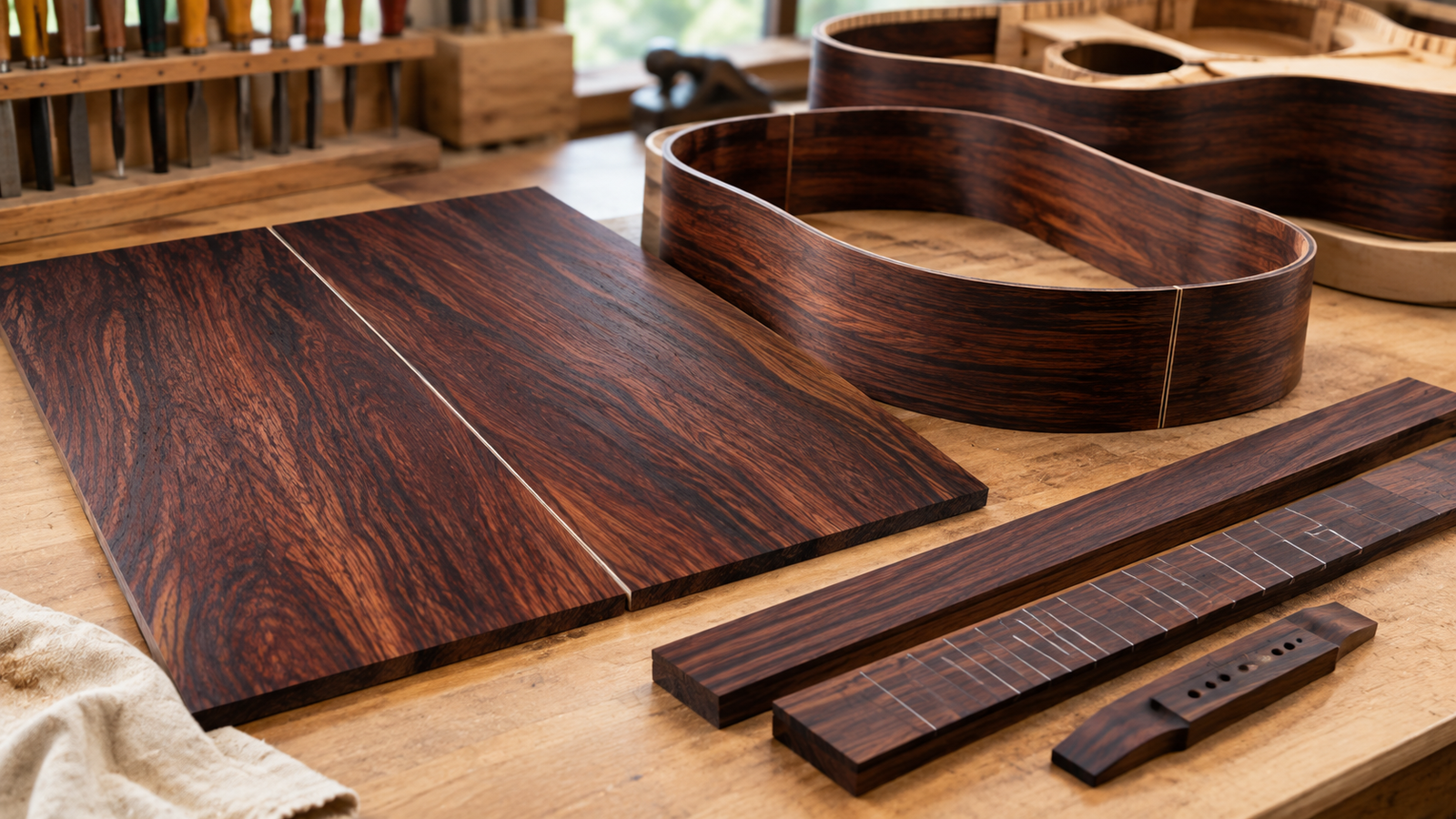
For custom guitar projects, the visual appeal of Congo Rosewood can be particularly relevant when selecting fingerboards, back and side sets, or decorative components.
Density and Physical Properties
Congo Rosewood is often described in the timber trade as a dense hardwood. However, because the commercial name may refer to different Dialium species, a single density range should not be assumed to apply to every piece.
Actual density depends on the species, growing conditions, moisture content, and the individual board. Buyers should request species-specific technical information and measured moisture content when available.
High-density hardwoods can offer good hardness and wear resistance, which may make them suitable for applications such as fingerboards and bridges. At the same time, dense wood can require careful machining, sharp tooling, and appropriate processing techniques.
Weight is another important consideration. A dense piece of wood may add noticeable weight to a finished instrument, particularly when used in larger components.
For this reason, Congo Rosewood should be evaluated according to the intended application rather than assuming that high density automatically makes it suitable for every guitar design.
Tonal Characteristics
The tonal contribution of a particular wood depends on several factors, including its physical properties, the dimensions of the component, the instrument’s construction, and the overall design.
Congo Rosewood is sometimes discussed as a potentially dense, firm hardwood for guitar applications. However, its precise acoustic behavior should not be generalized across all Dialium species without reliable measurements and instrument-specific testing.
When evaluating Congo Rosewood for a guitar project, consider the following characteristics:
- Density and stiffness: These properties can influence how a wooden component responds to vibration and how it contributes to the overall instrument.
- Weight: Higher-density material may add weight, which is especially relevant when selecting wood for larger electric guitar components.
- Sustain and articulation: These are characteristics of the complete instrument and cannot be reliably predicted from density alone.
- Construction and application: The effect of a wood used for a fingerboard or bridge may differ from its effect when used for an acoustic guitar back and sides.
For luthiers, the best approach is to evaluate Congo Rosewood through the properties of the actual stock, its intended use, and practical experience with the material.
Common Applications
Congo Rosewood may be considered for several guitar-making applications, depending on the exact species, dimensions, and quality of the available material.
Fingerboards
Dense hardwoods are commonly considered for guitar fingerboards because they can offer useful hardness and wear resistance.
Congo Rosewood may be an option for custom fingerboard projects when the material has suitable dimensions, stability, and machining characteristics. Its deep reddish-brown appearance can also provide a distinctive alternative to more familiar fingerboard woods.
Bridges
Some hardwoods are used for guitar bridges because of their hardness, dimensional requirements, and ability to withstand string tension and repeated use.
Congo Rosewood may be evaluated for this purpose when its physical properties and machining behavior are suitable for the design.
Back and Sides
Selected Dialium material may be considered for acoustic guitar back and side sets.
For this application, buyers should pay particular attention to board dimensions, grain orientation, moisture content, matching, and the quality of the drying process.
Decorative Accents
The distinctive color of Congo Rosewood may also make it suitable for smaller decorative components, such as knobs, binding, and other custom details.
For these applications, appearance, workability, and the availability of appropriately sized pieces may be more important than the acoustic contribution of the wood.
Sourcing and Compliance Notes
When sourcing Congo Rosewood, it is important to establish the exact botanical identity and country of origin of the material.
Trade names can be inconsistent, and different Dialium species may have different physical properties, sourcing conditions, and regulatory requirements.
For international buyers, compliance should be checked against the actual species, country of harvest, product form, and destination market.
Relevant requirements may include:
- European Union: The EU Deforestation Regulation (EUDR) may apply to certain wood products, depending on the product classification, species, and applicable rules.
- United States: The Lacey Act may require declarations and compliance with applicable laws concerning the source of imported wood products.
- Australia: The Illegal Logging Prohibition Act and related requirements may apply to certain imported timber products.
These requirements can change, and their applicability should not be determined solely by the commercial name “Congo Rosewood.” Buyers should confirm current requirements with qualified customs or regulatory professionals before importing.
When selecting Congo Rosewood stock, also pay attention to the following factors.
1. Grain Consistency
Look for boards with suitable grain orientation and a consistent appearance for the intended application. Natural color variation is not necessarily a defect, but excessive irregularity may affect the appearance of matched sets.
2. Moisture Content
Ask the supplier for the actual moisture content of the stock and details of the drying process.
A moisture content of around 8%–12% is commonly used as a reference for many indoor woodworking applications, but the appropriate target depends on the destination climate, storage conditions, and intended use.
3. Cracks and Insect Damage
Inspect the material for checks, splits, insect holes, and other defects. Dense hardwoods are not immune to damage caused by improper drying, transportation, or storage.
4. Supply Stability
Because Congo Rosewood is a relatively specialized trade category, buyers should establish a reliable supply relationship and confirm the consistency of species identification, dimensions, grading, and documentation.

Final Thoughts
Congo Rosewood offers an interesting option for guitar makers seeking a distinctive African hardwood with a deep reddish-brown appearance.
Its potential applications include fingerboards, bridges, acoustic guitar back and sides, and decorative components. However, its exact physical and acoustic properties depend on the species and the individual piece of wood.
For buyers, the most important considerations are accurate species identification, suitable dimensions, moisture content, processing quality, and reliable sourcing documentation.
If you are considering Congo Rosewood for a custom guitar project, request detailed product photographs and technical information before making a purchasing decision.
With this article, we have completed our introduction series for our priority tonewood species, covering Sapele, Pommele Sapele, Maple, Black Walnut, Pau Ferro, Ziricote, Pale Moon Ebony, Yellow Heart Nanmu, and Congo Rosewood.
Next, we will move into detailed head-to-head comparison articles to help guitar makers and tonewood buyers make more informed sourcing decisions.
Congo Rosewood Guitar Tonewood Collection
Contact Tonewood Global for Wholesale Tonewood
Looking for Congo Rosewood stock for your next build?
Visit our [Congo Rosewood Guitar Tonewood Collection] to explore available stock, dimensions, and grades. For wholesale inquiries or additional product information, please [contact Tonewood Global].
Worldwide shipping is available.