
When choosing wood for a guitar, luthiers often compare Pau Ferro vs Rosewood because both can offer attractive grain, high density and excellent durability.
But are they actually the same type of wood?
No.
Pau Ferro and true rosewoods are botanically different. Pau Ferro is associated with the Machaerium genus, while many woods commonly called rosewood belong to the Dalbergia genus.
For guitar makers, the more useful question is not simply which wood is “better,” but rather:
Which wood is better for your specific guitar application?
This guide compares Pau Ferro and rosewood for guitar fingerboards, acoustic guitar back and sides, appearance, workability and material selection.
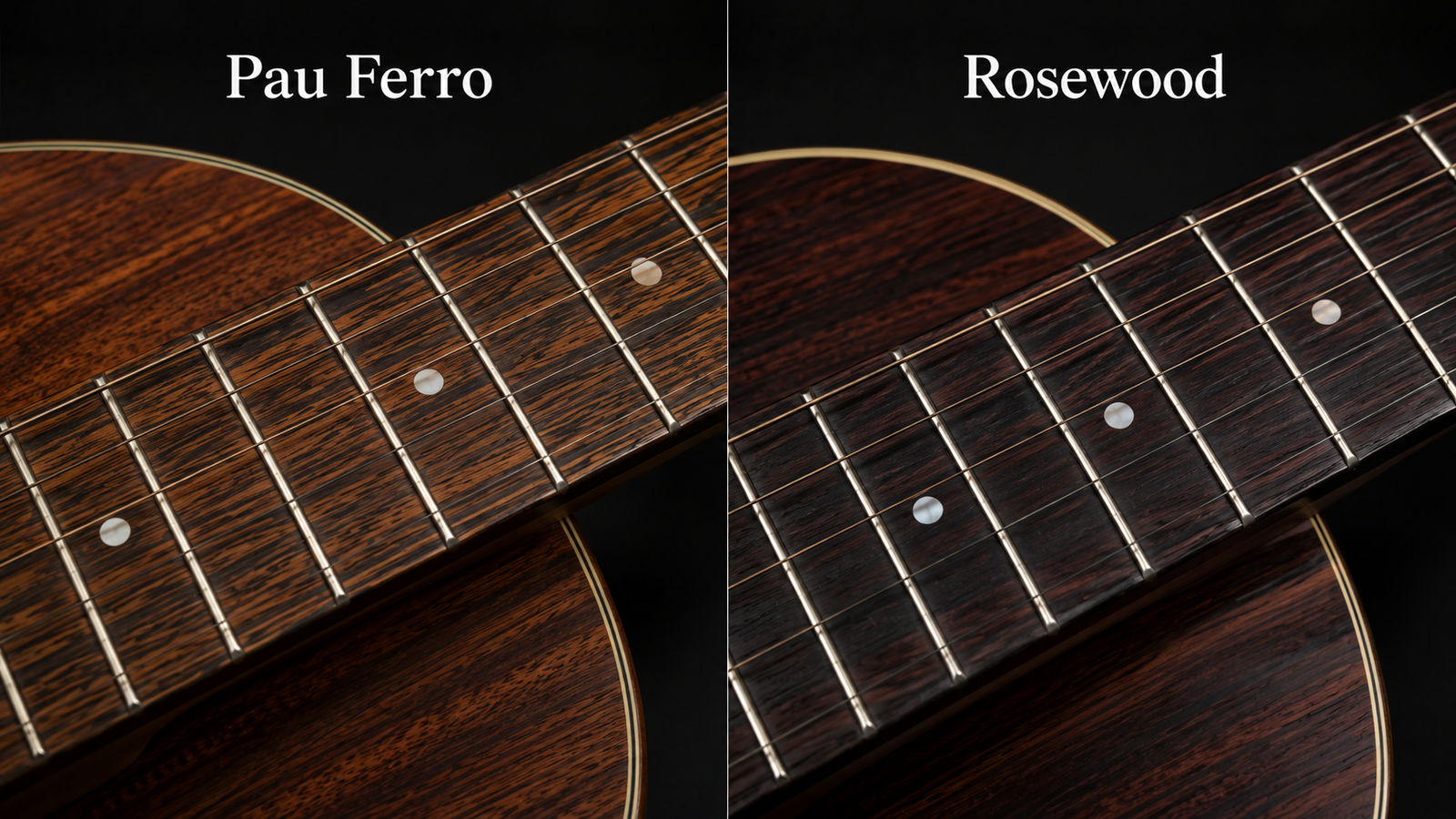
What Is Pau Ferro?
Pau Ferro is a commercial name associated with hardwoods in the Machaerium genus.
One important species associated with the Pau Ferro trade is Machaerium scleroxylum Tul., an accepted species according to the Royal Botanic Gardens, Kew. Its native range includes Bolivia, Brazil and Paraguay. (Plants of the World Online)
The name “Pau Ferro” is also associated in the timber trade with names such as:
- Santos Rosewood
- Morado
- Caviuna
- Pau Ferro
Because commercial names can vary between markets, professional buyers should confirm the botanical name and origin of the material rather than relying only on a trade name.
What Is Rosewood?
“Rosewood” is not the name of one single tree species.
It is a broad commercial term that can refer to different hardwood species, particularly species in the Dalbergia genus.
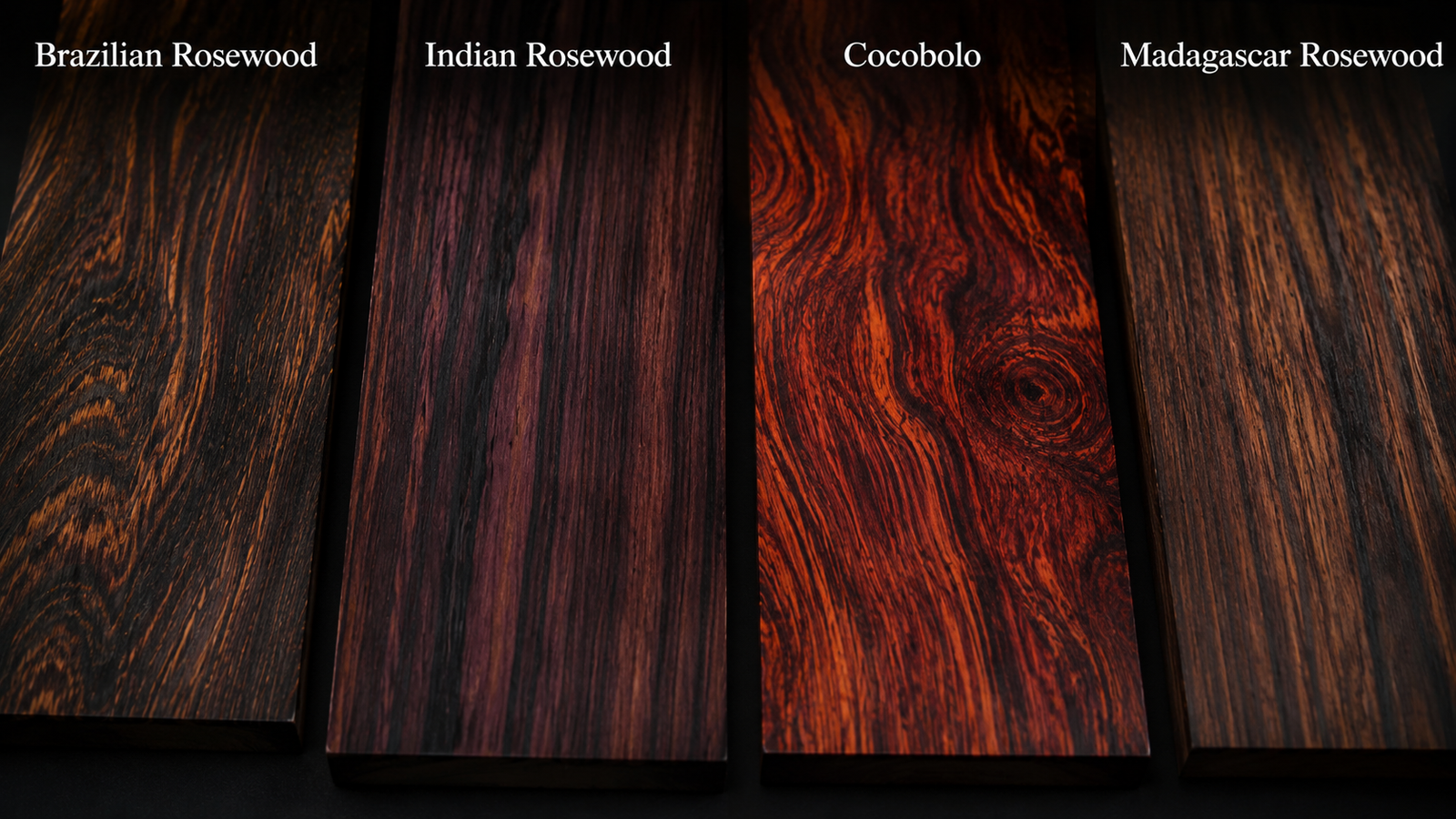
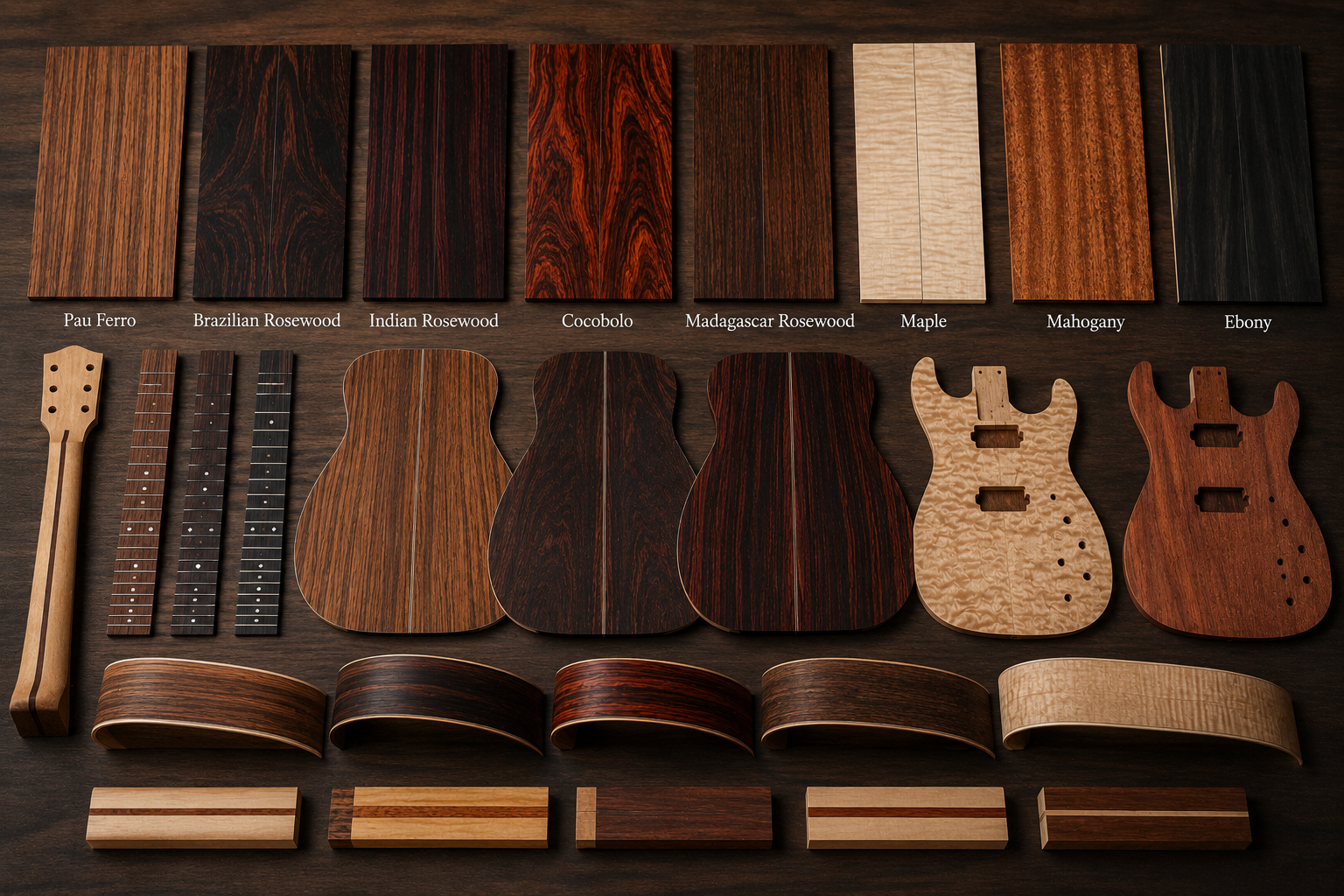
Examples include:
- Brazilian Rosewood — Dalbergia nigra
- Indian Rosewood — Dalbergia latifolia
- Cocobolo — Dalbergia retusa
- Madagascar Rosewood — several Dalbergia species
Therefore, when comparing Pau Ferro with rosewood, it is important to specify which rosewood species you are comparing.
This distinction matters because different rosewood species can have very different appearance, density, workability, availability and trade requirements.
Pau Ferro vs Rosewood: Are They the Same Wood?
No.
Pau Ferro and rosewood should not be treated as the same botanical material.
Pau Ferro is associated with Machaerium, while many commercially important rosewoods belong to Dalbergia.
The similarity comes partly from appearance and traditional trade names.
The name “Santos Rosewood” is particularly confusing because it contains the word “Rosewood,” even though Pau Ferro is not Brazilian Rosewood (Dalbergia nigra).
For professional guitar wood purchasing, it is therefore better to specify:
Pau Ferro — botanical species and grade
rather than simply ordering “rosewood.”
Pau Ferro vs Rosewood: Quick Comparison
| Feature | Pau Ferro | Rosewood |
|---|---|---|
| Botanical group | Machaerium | Often Dalbergia, depending on species |
| Appearance | Brown, reddish-brown, golden-brown and contrasting grain | Species-dependent; often brown, reddish, purple or dark |
| Density | Generally high | Generally high, species-dependent |
| Hardness | Hard and durable | Generally hard and durable |
| Fingerboards | Excellent application | Excellent application |
| Acoustic guitar back & sides | Suitable for selected sets | Widely used for many species |
| Grain character | Often strong and contrasting | Highly variable |
| Availability | Depends on species and source | Depends strongly on species and regulations |
| Trade requirements | Species/source should be verified | Some species have CITES controls |
| Best comparison method | Compare specific species and grade | Compare specific species and grade |
The table above should be viewed as a general guide. Individual boards can vary significantly.
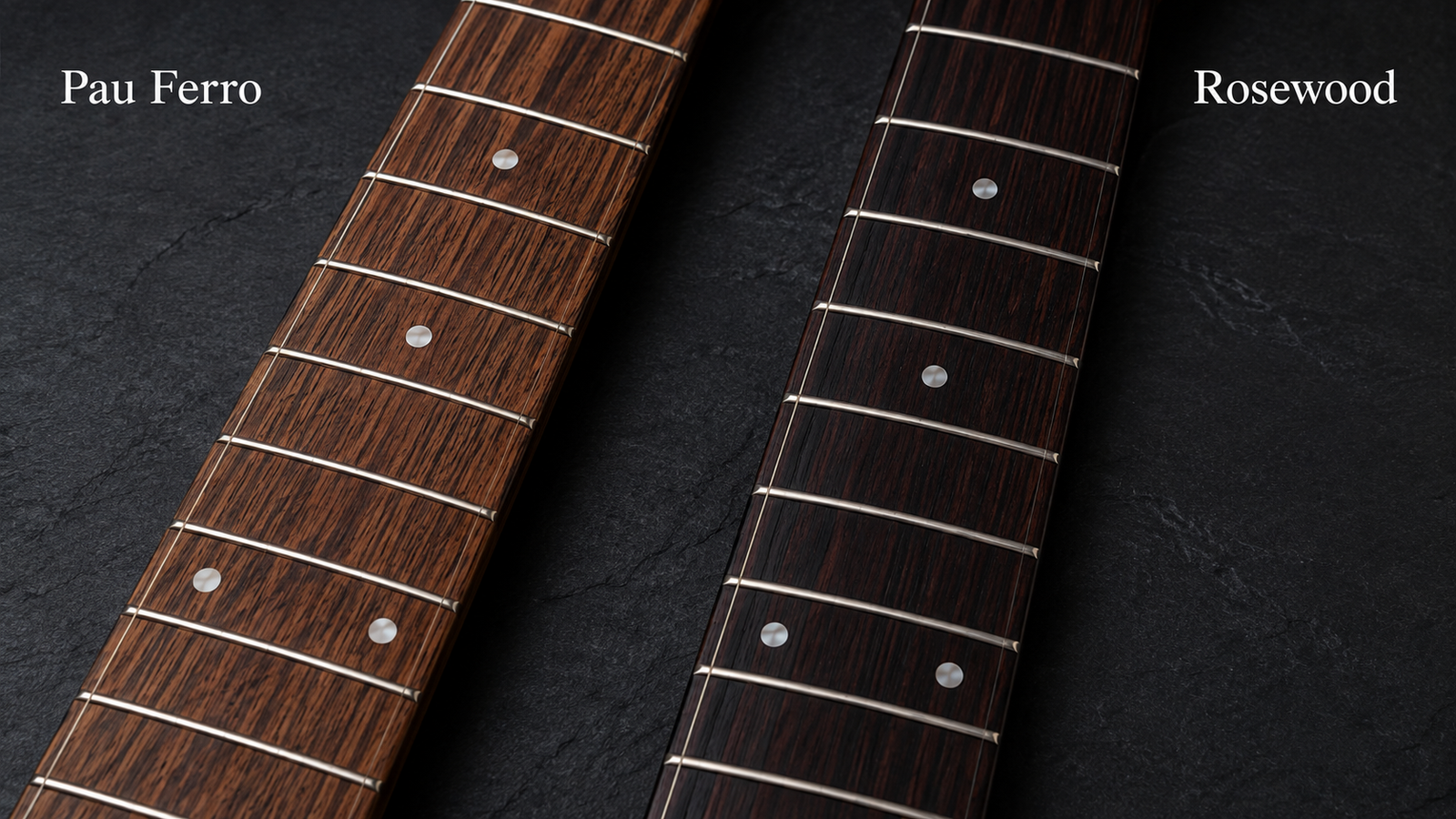
Pau Ferro vs Rosewood for Guitar Fingerboards
Both Pau Ferro and rosewood can be excellent choices for guitar fingerboards.
A fingerboard requires a material that can withstand repeated contact with strings, fretting pressure, machining and finishing.
Why Choose Pau Ferro?
Pau Ferro can be attractive when a builder wants:
- A dense hardwood fingerboard
- Strong natural grain variation
- Brown or reddish-brown color
- A distinctive appearance
- An alternative to traditional rosewood
- An alternative visual style to very dark ebony
Pau Ferro is particularly interesting for custom and boutique guitars where the appearance of the fingerboard is part of the overall instrument design.
Why Choose Rosewood?
Rosewood has a long history in guitar making and is available in many visually distinctive species.
Depending on the species, rosewood can offer:
- Rich natural color
- Strong grain patterns
- High density
- Excellent durability
- A traditional guitar aesthetic
However, the exact species is important because “rosewood” covers multiple different woods.
Pau Ferro vs Rosewood for Acoustic Guitar Back and Sides
For acoustic guitar back and sides, the comparison becomes more complicated.
The luthier needs to consider:
- Density
- Stiffness
- Weight
- Internal damping
- Grain orientation
- Thickness
- Moisture content
- Set matching
- Availability
- Sustainability and trade requirements
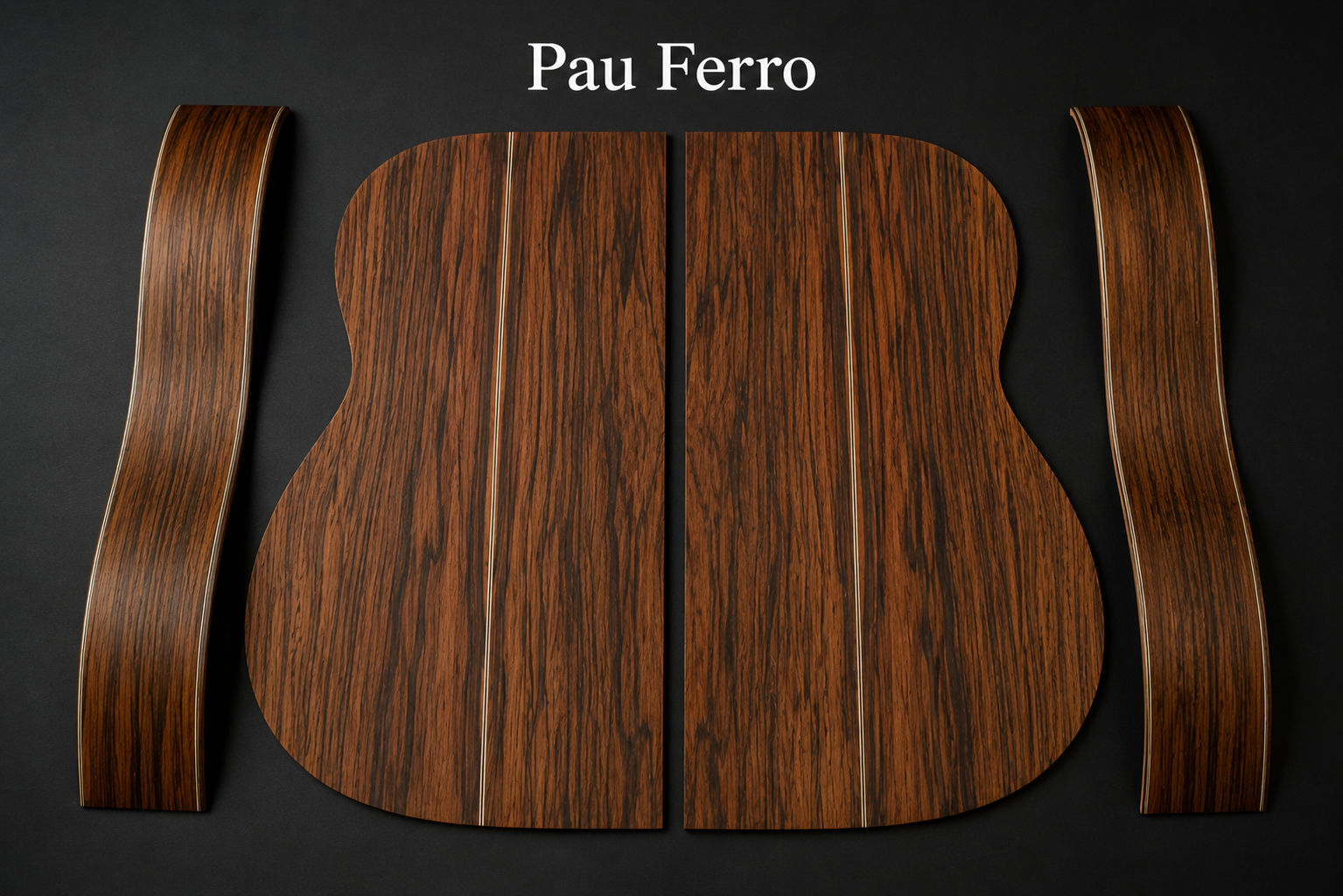
A high-quality Pau Ferro set can be visually impressive and suitable for custom acoustic guitars.
Rosewood remains one of the most traditional choices for premium acoustic guitar construction, but not every rosewood species behaves in exactly the same way.
For this reason, a direct statement such as “Pau Ferro is better than rosewood” is too simplistic.
The better question is:
Which specific Pau Ferro and which specific rosewood are being compared?
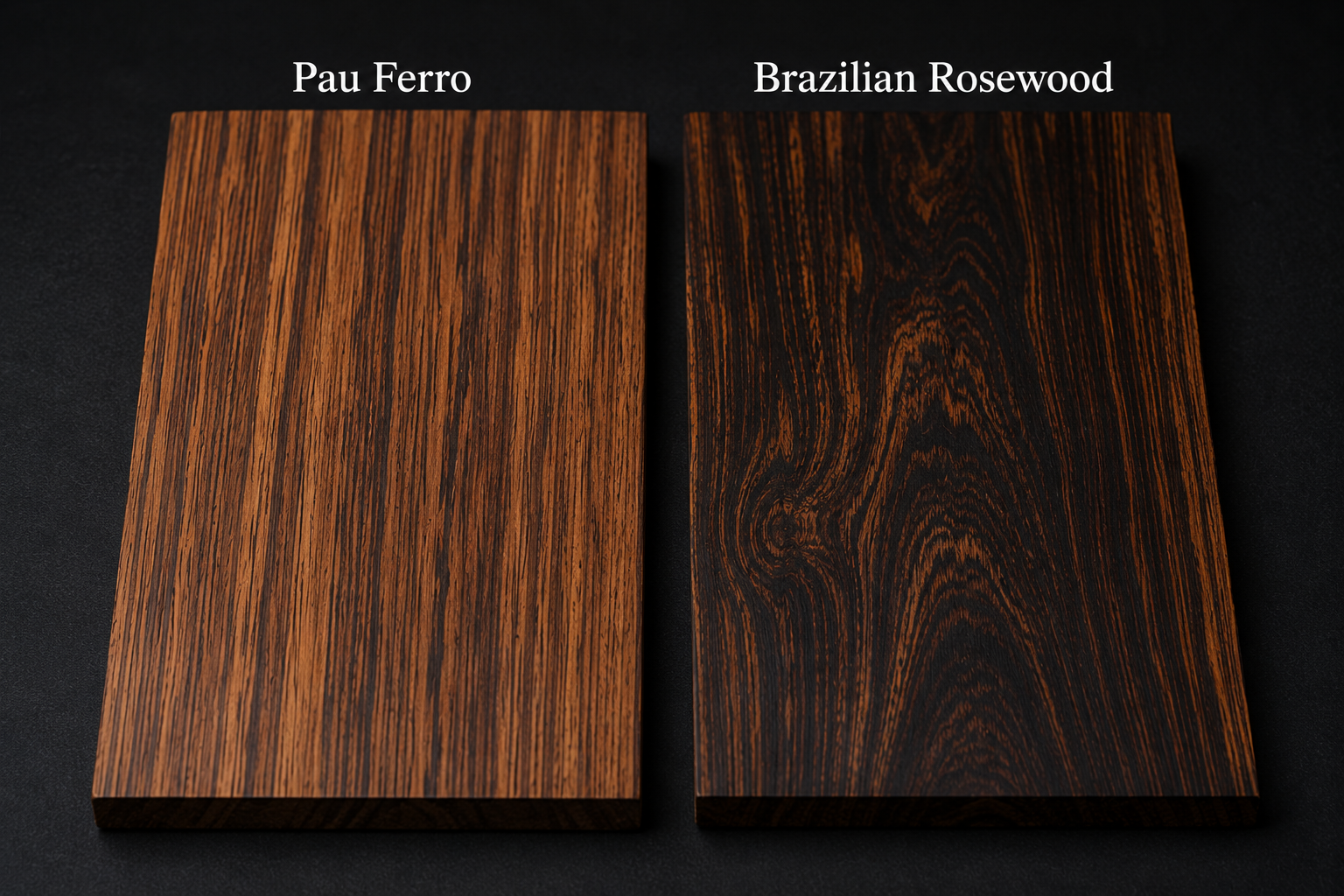
Pau Ferro vs Brazilian Rosewood
This is an especially important distinction.
Brazilian Rosewood is Dalbergia nigra, while Pau Ferro associated with Machaerium scleroxylum is a different species and genus. (Plants of the World Online)
Brazilian Rosewood is also subject to CITES Appendix I controls. CITES documentation identifies Dalbergia nigra as Brazilian Rosewood and lists it in Appendix I. (CITES)
Therefore:
Pau Ferro should not be marketed or described as Brazilian Rosewood.
A product description such as:
Pau Ferro / Santos Rosewood
can be useful when explaining commercial terminology, but it is better to clearly identify the botanical species.
For example:
Pau Ferro Guitar Tonewood — Machaerium scleroxylum
This is much clearer for professional buyers.
Pau Ferro vs Indian Rosewood
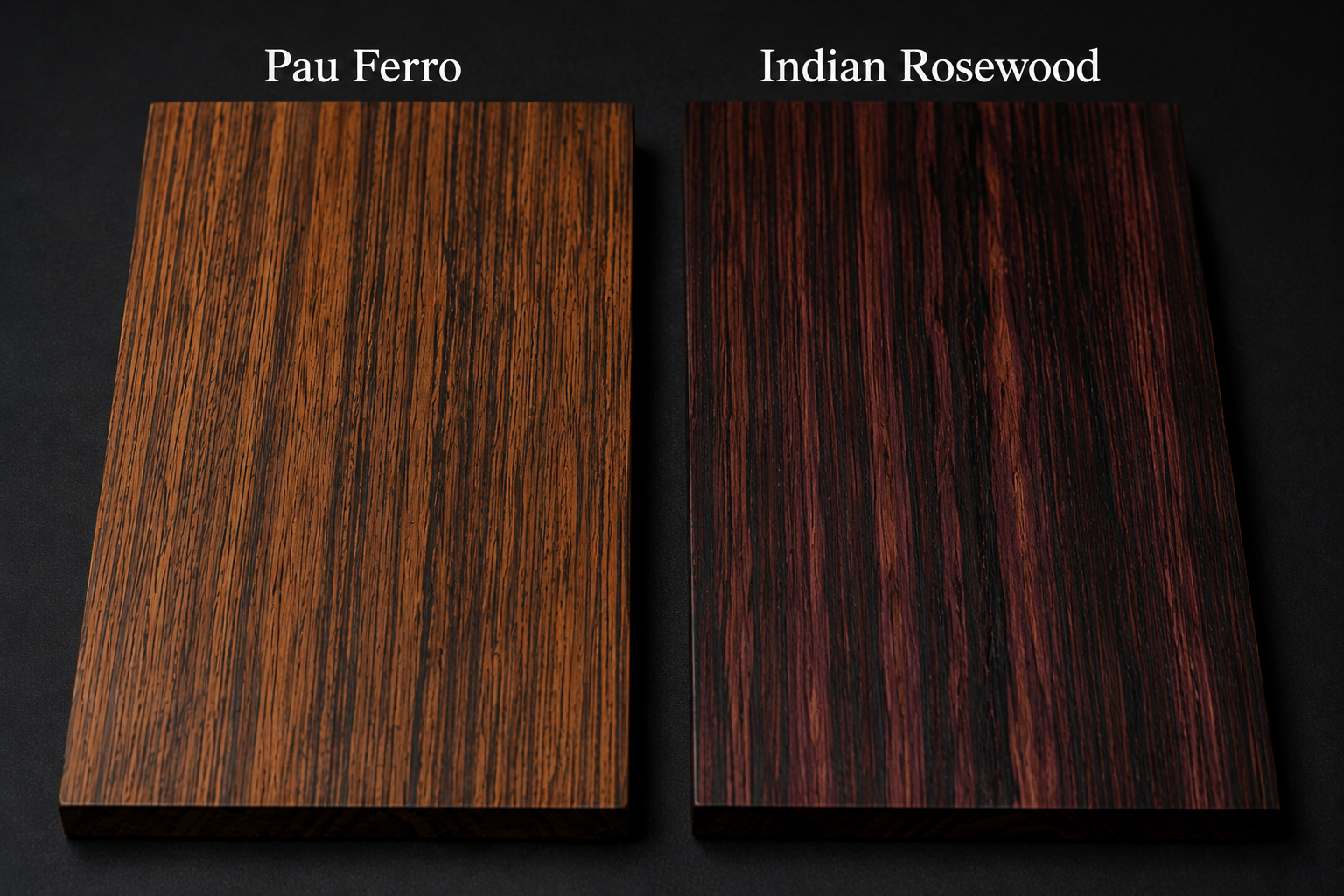
Indian Rosewood is another common comparison.
Indian Rosewood generally refers to Dalbergia latifolia, while Pau Ferro belongs to Machaerium.
For guitar builders, the choice can depend on:
- Desired appearance
- Available dimensions
- Grain pattern
- Weight
- Workability
- Cost
- Regulatory requirements
- Customer preference
If the goal is to achieve a traditional rosewood appearance, Indian Rosewood may be preferred.
If the goal is to create a distinctive custom appearance while using a different hardwood, Pau Ferro can be an attractive option.
Is Pau Ferro a Good Alternative to Rosewood?
For many guitar applications, yes.
But “alternative” does not mean “identical.”
Pau Ferro can be considered as an alternative when a guitar maker is looking for:
- A dense hardwood
- A durable fingerboard material
- A visually distinctive tonewood
- A rosewood-like aesthetic without being the same species
- A material suitable for custom guitar production
The final decision should always be based on the specific application and material specifications.
Which Is Better for Guitar Fingerboards?
There is no universal winner.
Choose Pau Ferro if you want:
- Brown or reddish-brown natural color
- Strong grain variation
- A distinctive custom appearance
- A dense hardwood fingerboard
- An alternative to traditional rosewood
Choose Rosewood if you want:
- A traditional guitar appearance
- A particular rosewood species
- A familiar material for established guitar designs
- A specific grain or color characteristic
For boutique guitar makers, Pau Ferro can be particularly interesting because every board can have a different visual character.
Which Is Better for Acoustic Guitar Back and Sides?
For acoustic guitar back and sides, both materials can be suitable, but the choice should be based on the actual wood set rather than the species name alone.
A professional luthier should evaluate:
- Density
- Stiffness
- Grain orientation
- Moisture content
- Thickness
- Weight
- Visual matching
- Defects
- Availability
- Regulatory considerations
A well-selected guitar set is often more important than simply choosing a famous species.
Does Pau Ferro Sound Like Rosewood?
This question requires some caution.
The sound of a guitar is determined by the entire instrument, including:
- Body design
- Bracing
- Top wood
- Back and side wood
- Neck construction
- Bridge
- Fingerboard
- Scale length
- Strings
- Finish
- Setup
- Construction technique
Therefore, it is not accurate to say that every Pau Ferro guitar will sound exactly like a rosewood guitar.
Different wood species can influence the instrument’s mechanical and acoustic behavior, but the final sound is the result of the complete instrument.
For this reason, luthiers should select tonewood based on the complete design rather than expecting one wood species to automatically produce a specific sound.
How to Choose Between Pau Ferro and Rosewood
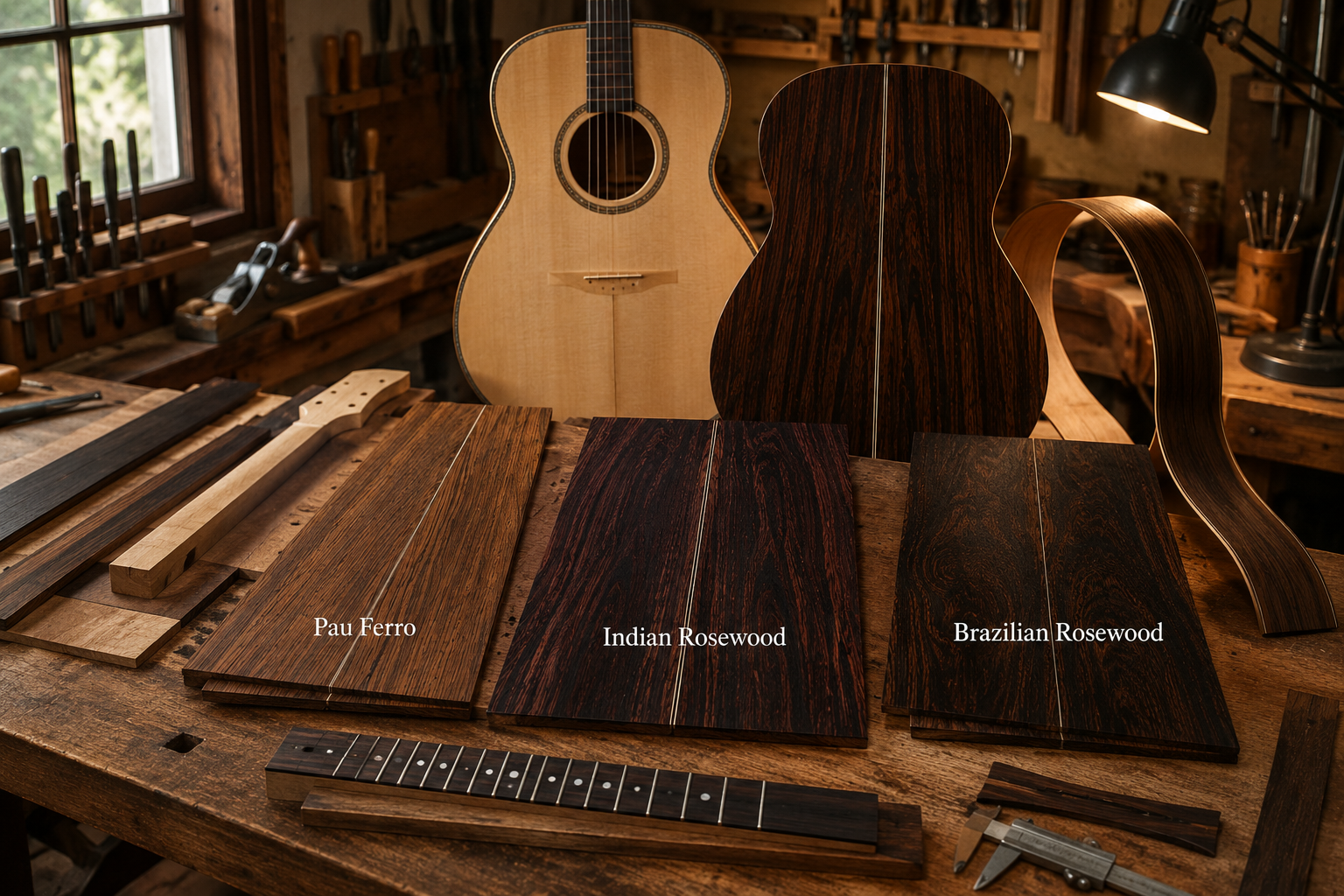
If you are deciding between the two, consider the following questions.
1. What part of the guitar are you building?
A fingerboard has different requirements from an acoustic guitar back and side set.
2. What appearance do you want?
Pau Ferro often offers contrasting brown and reddish-brown grain, while rosewood appearance varies considerably between species.
3. What dimensions do you need?
Thickness and blank dimensions should be confirmed before purchasing.
4. What is the moisture condition?
Properly dried and stored tonewood is important for guitar construction.
5. What is the botanical species?
Do not purchase an expensive exotic wood based only on a trade name.
6. What are the import and export requirements?
Regulatory requirements depend on the exact species, origin, destination and form of the material.
This is particularly important when comparing Pau Ferro with regulated rosewood species.
Pau Ferro: A Practical Rosewood Alternative for Guitar Makers
Pau Ferro is not a replacement for every type of rosewood.
However, it can be a very useful alternative for guitar makers who want a hard, attractive and distinctive hardwood for selected applications.
Its strongest potential applications include:
- Guitar fingerboards
- Acoustic guitar back and sides
- Custom guitar components
- Boutique guitar projects
- Bass guitar components
- Decorative instrument parts
For manufacturers, consistency is also important.
A professional supplier should be able to provide information about:
- Botanical species
- Wood grade
- Dimensions
- Thickness
- Moisture condition
- Grain orientation
- Quantity
- Packaging
- Shipping options
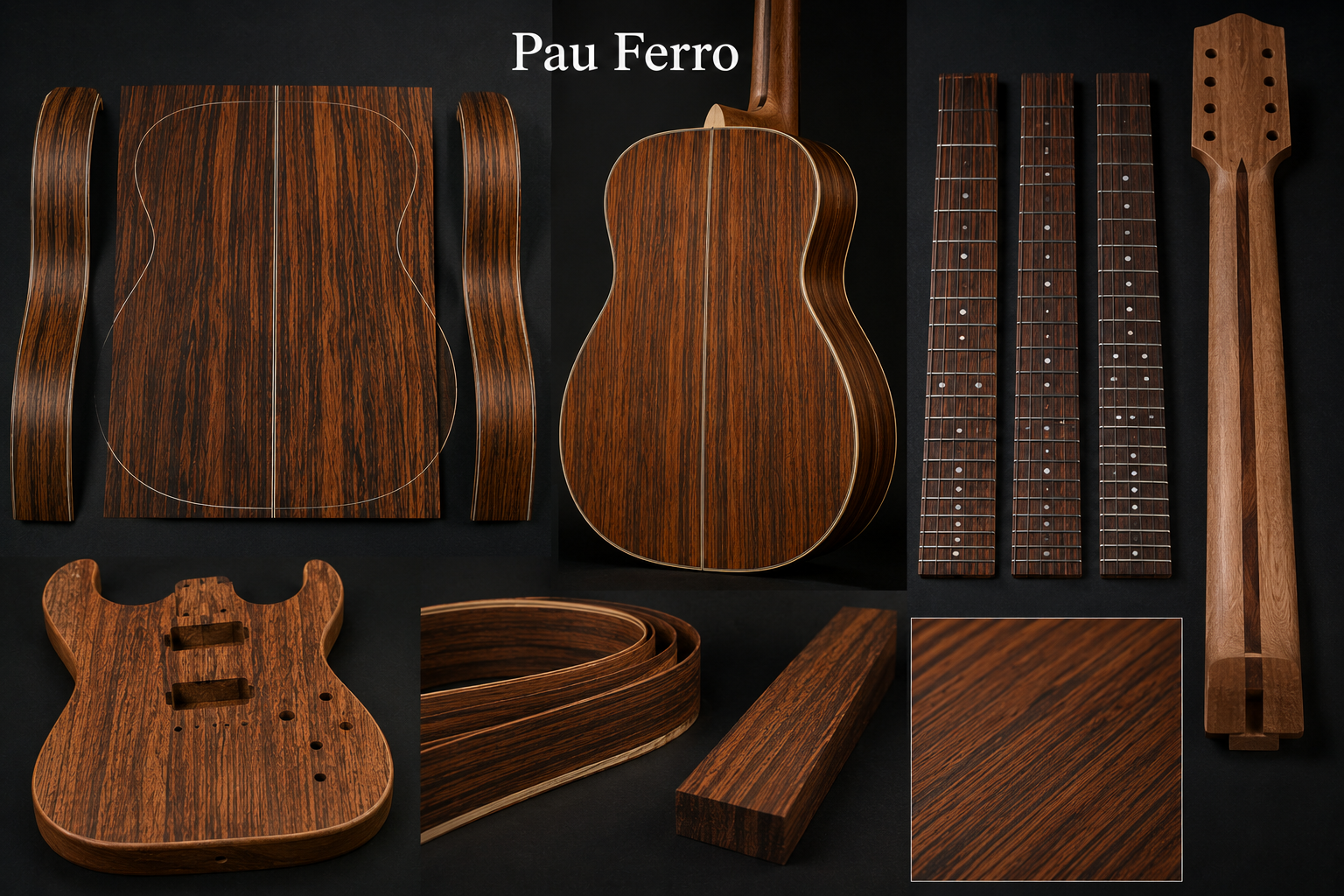
Looking for Pau Ferro Guitar Tonewood?
Tonewood Global supplies guitar tonewoods for luthiers, guitar makers and musical instrument manufacturers.
We can provide Pau Ferro material for different guitar-making applications, subject to available grades, dimensions and specifications.
Explore Guitar Tonewoods →
Read: Pau Ferro for Guitar — Complete Guide →
Contact Tonewood Global for Wholesale Tonewood →
Final Thoughts
Pau Ferro and rosewood are both valuable guitar woods, but they should not be treated as identical materials.
The most important distinction is botanical:
Pau Ferro is associated with the Machaerium genus, while many true rosewoods belong to the Dalbergia genus.
For guitar makers, Pau Ferro can provide a distinctive combination of appearance, hardness and versatility.
Rather than asking whether Pau Ferro is simply “better” than rosewood, compare the specific species, grade, dimensions and intended application.
For a custom guitar, the best tonewood is the material that matches the builder’s design, construction method and aesthetic requirements.
Looking for Pau Ferro guitar wood? Contact Tonewood Global to discuss available sizes, grades and wholesale supply.