
Back and sides form the resonating box of an acoustic guitar, shaping its appearance and contributing to its acoustic response. For custom guitar builders and buyers, choosing these woods involves balancing sound, weight, workability, visual character, and availability.
Traditional rosewoods remain popular, but builders also work with alternatives that offer distinctive grain and different processing characteristics. This guide compares three options: Pau Ferro, Ziricote, and Congo Rosewood (Dialium spp.), with Sapele and Black Walnut included as reference points.

What to Look at First
When choosing back and sides wood, builders typically consider:
- Acoustic response: How the back and sides interact with the top, air cavity, and overall construction.
- Density and stiffness: These influence weight and how the plates behave at the thickness chosen by the builder.
- Bendability: Sides must be bent into shape, so grain direction, defects, thickness, and bending technique matter.
- Stability: Proper drying and workshop acclimation help limit movement across the large surface of the back.
- Appearance: Color, grain, and figure strongly influence the finished instrument’s character.
- Sourcing and documentation: Accurate species identification and origin information are important for international orders.
The tonal descriptions below reflect common builder impressions rather than guaranteed results. Body shape, top wood, bracing, plate thickness, and the luthier’s design all influence the finished instrument.
Pau Ferro: A Clear, Balanced Alternative
Pau Ferro (Machaerium scleroxylon) is familiar as a fingerboard wood and is also used for acoustic guitar back and sides. Its contrasting streaks offer a decorative appearance without requiring highly figured grain.
Although sometimes sold under names such as Bolivian Rosewood, Pau Ferro belongs to the genus Machaerium, rather than Dalbergia, the genus associated with true rosewoods.
- Density: A dense hardwood; published values and individual boards vary, so consider the weight of the actual set.
- Acoustic character: Often described by builders as clear and focused, with balanced mids and defined note separation.
- Bendability: Suitable stock can be bent successfully, but grain orientation, thickness, and the bending schedule need attention.
- Gluing: Prepare fresh, clean joint surfaces and follow the adhesive manufacturer’s guidance. Test bonding if surface extractives cause concern.
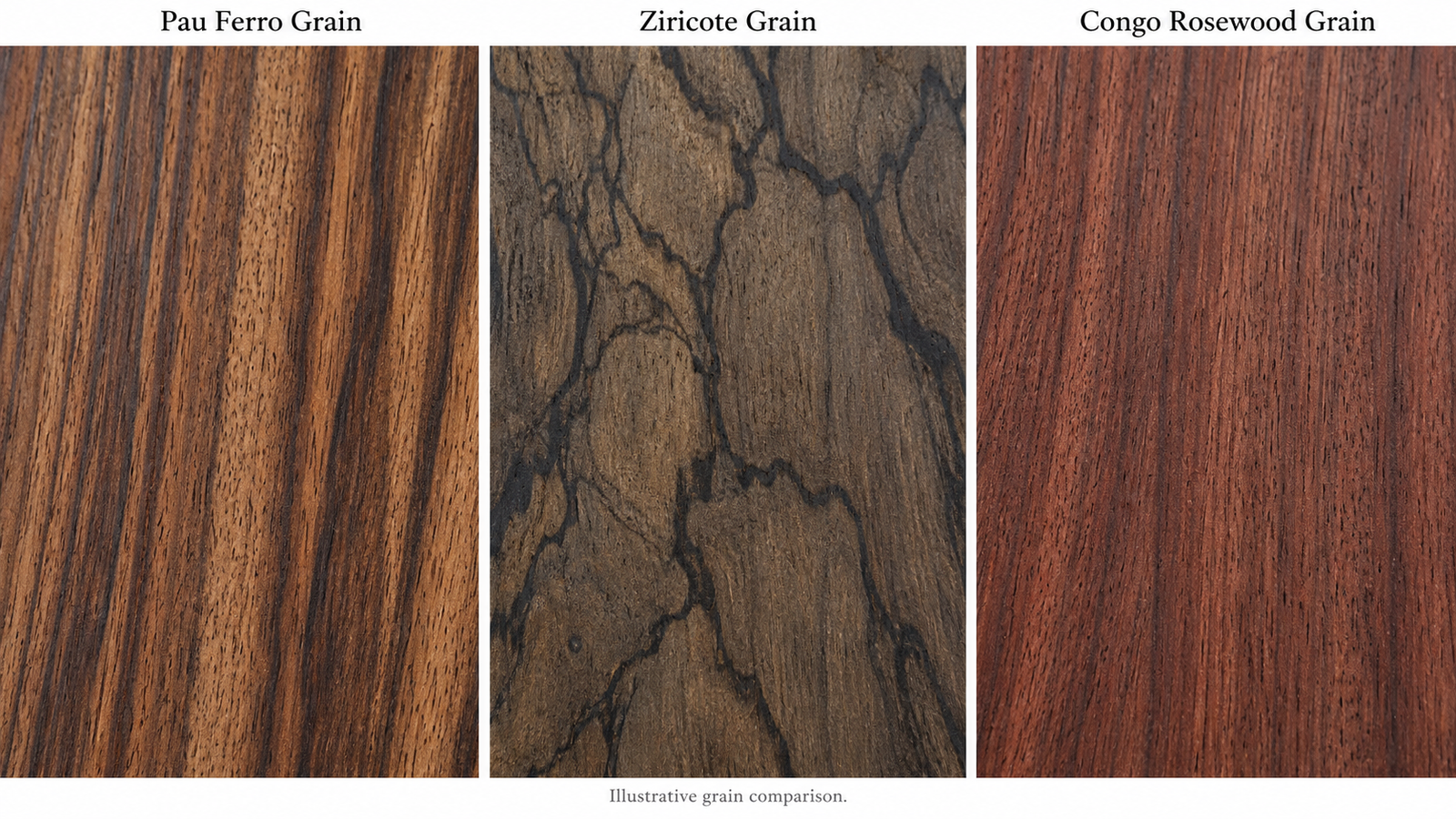
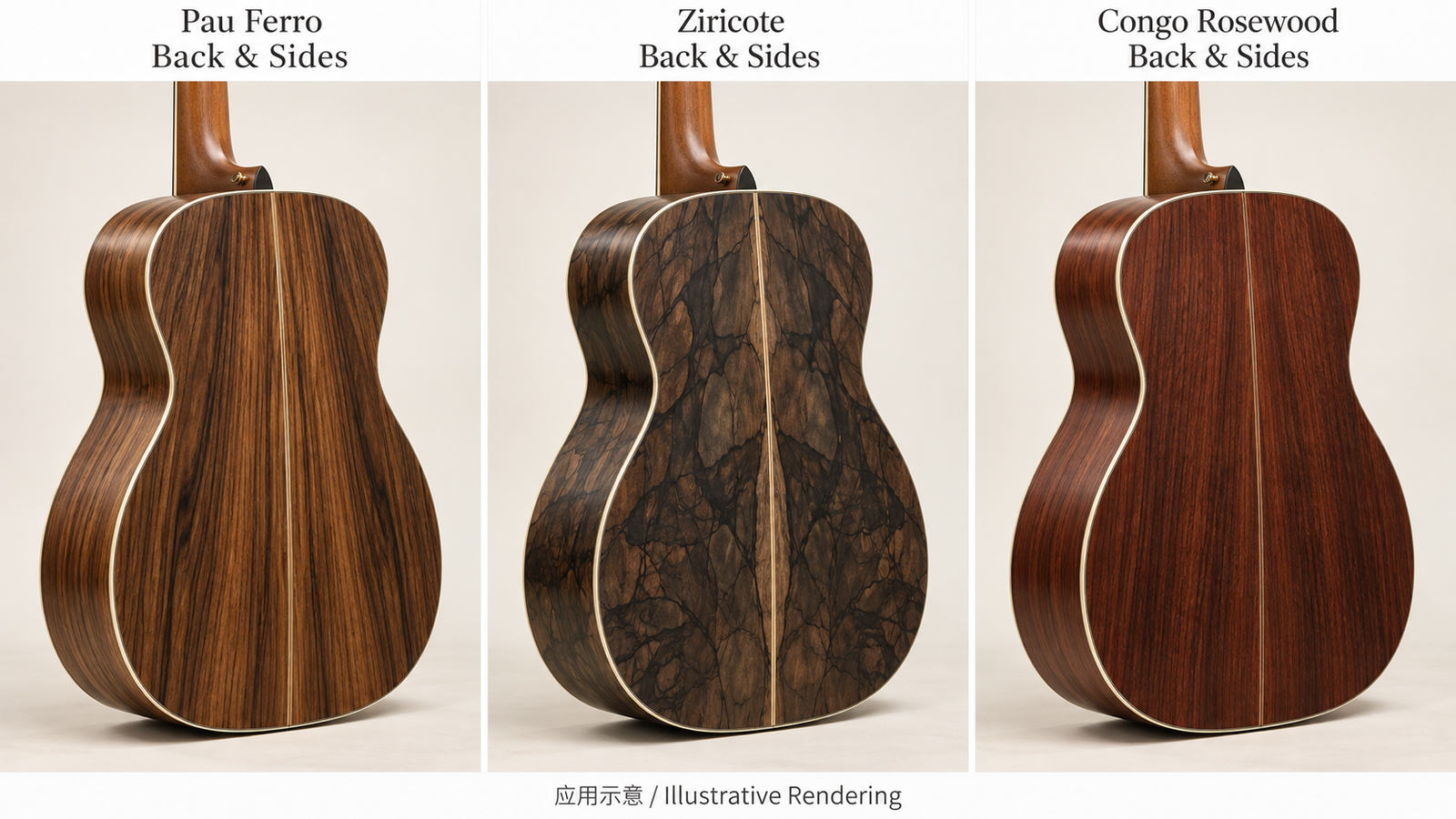
- Appearance: Brown to purplish-brown, often with darker contrasting streaks.
- Sourcing: Request the botanical name and origin rather than relying only on the trade name.
- Best for: Builders seeking a striped appearance and a focused acoustic character in an alternative to traditional rosewood.
Ziricote: The Visual Standout
Ziricote (Cordia dodecandra) is valued for its dramatic dark lines and landscape-like figure. A carefully selected bookmatched back can become the visual centerpiece of an acoustic guitar.
Its appearance varies substantially between sets, making photographs of the actual wood especially useful.
- Density: A dense hardwood that can produce a relatively heavy set; assess the individual boards.
- Acoustic character: Commonly described as clear and resonant, with rich overtones, although the finished result depends on construction.
- Bendability: Requires care. Irregular grain and existing checks can increase the risk of cracking during bending.
- Appearance: Gray-brown to dark brown, with black lines, spiderweb patterns, and sometimes contrasting pale sapwood.
- Stock inspection: Check for end checks, surface cracks, and defects that may become more apparent during machining.
- Sourcing: Confirm the botanical identity, origin, and available legal sourcing records.
- Best for: Custom guitars where distinctive figure is a priority and the builder is comfortable processing demanding stock.
Congo Rosewood (Dialium spp.): A Dense African Option
Congo Rosewood is a trade name used for certain African woods identified as Dialium species. It is not a true Dalbergia rosewood, and the trade name alone does not establish its precise botanical identity.
Compared with more established acoustic woods, publicly documented use is limited. Builders should assess the actual stock and test their processing methods before committing to a complete instrument.
- Density: Often sold as a very dense hardwood, with some stock reported around 0.90–1.05 g/cm³. Species, moisture content, and individual boards affect the value.
- Acoustic character: Evaluate through the builder’s own plate assessment and completed instruments. Density alone does not establish bass response, clarity, or sustain.
- Bendability: Test a sample first. Suitable thickness, grain direction, and a controlled bending process are important.
- Appearance: Typically sold in reddish-brown to dark brown tones, with the exact color and grain depending on the stock.
- Workability: Dense material can demand sharp tools and careful machining.
- Sourcing: Ask for the most precise species identification available, the country of harvest, and supporting sourcing records.
- Best for: Builders interested in exploring a less familiar material and willing to allow time for bending and construction trials.
Reference Options: Sapele and Black Walnut
Sapele and Black Walnut provide useful comparisons when considering cost, weight, appearance, and workshop handling.
Sapele
Sapele (Entandrophragma cylindricum) is widely used in acoustic guitar construction. It offers reddish-brown color, attractive ribbon figure, and a familiar working material for many builders.
- Often described as having a focused, warm midrange.
- Generally a practical choice for back and sides when the stock is suitable.
- Interlocked grain can require care during planing and finishing.
- Pommele figure offers a more decorative option, though highly figured stock needs additional attention.
Black Walnut
Black Walnut (Juglans nigra) offers brown color and a generally lighter-weight alternative to the denser woods in this guide.
- Often associated with a warm, direct acoustic character.
- Typically approachable to machine and bend when properly selected.
- Grain and color range from relatively uniform to strongly figured.
- Useful for builders seeking a balance of appearance, weight, and workability.
Quick Reference Table
| Wood | Typical Weight Character | Common Builder Descriptions of Sound | Bending Considerations | Appearance |
|---|---|---|---|---|
| Pau Ferro | Dense | Clear, focused, balanced | Check grain and adjust the bending process | Brown and purplish-brown streaks |
| Ziricote | Dense | Clear, resonant, rich in overtones | Inspect carefully for checks; bend conservatively | Dark lines and landscape-like figure |
| Congo Rosewood (Dialium spp.) | Often very dense | Limited documented use; evaluate through testing | Sample bending recommended | Reddish-brown to dark brown |
| Sapele | Moderate weight | Focused, warm mids | Generally practical; figured stock needs care | Reddish-brown with ribbon or pommele figure |
| Black Walnut | Generally lighter | Warm, direct | Typically approachable with suitable stock | Brown, sometimes with contrasting sapwood |
Note: These are broad comparisons, not performance specifications. Individual boards and construction choices can produce substantial differences.
Pairing With the Top
The top and its bracing play a major role in an acoustic guitar’s response. Back and sides should therefore be chosen as part of the complete design.
Some combinations worth exploring include:
- Spruce top + Pau Ferro back and sides: A familiar starting point for builders seeking clarity and a versatile response.
- Spruce top + Ziricote back and sides: Combines a traditional soundboard choice with highly decorative back and sides.
- Cedar top + Ziricote back and sides: An option to assess for a responsive instrument with a distinctive appearance.
- Spruce top + Congo Rosewood back and sides: A potential experimental pairing, supported by stock assessment and bending trials.
These combinations are starting points for design. A wood pairing alone cannot guarantee a particular tonal result.
Sourcing Tips for International Buyers
1. Ask for Stock Suitable for Bending
Confirm that the sides are intended for acoustic guitar construction. Ask about grain direction, defects, dimensions, and whether the supplier has experience bending the material.
A visually attractive board is not automatically a suitable side blank.
2. Check Moisture Content and Allow Acclimation
Ask how the wood was dried and when its moisture content was measured. Many suppliers offer tonewood around 8–12% moisture content, but the appropriate working condition depends on the workshop environment.
Allow the wood to acclimate before thicknessing, bending, or assembly. Supplier readings do not replace checks in the builder’s own workshop.
3. Request Photos of the Actual Set
For figured woods, request photographs of the specific back and sides being purchased.
Confirm whether the photos show dry wood, wetted wood, or a finished surface, as each can produce a different impression of color and contrast.
4. Confirm Species and Origin
Trade names can be ambiguous. Request botanical identification and country of harvest, particularly for material sold as Congo Rosewood.
Where possible, keep this information on the invoice or accompanying documentation.
5. Check Destination Requirements
International timber requirements depend on the species, product form, origin, destination, and rules in effect at the time of shipment.
Confirm applicable import and documentation requirements before ordering. Avoid assuming that any wood is automatically exempt or straightforward simply because it is marketed as a rosewood alternative.
Choosing the Right Set
Pau Ferro is worth considering for its contrasting stripes and reputation for a clear, focused response.
Ziricote stands out for its dramatic figure, with careful stock selection and processing forming part of the investment.
Congo Rosewood offers a less familiar option for builders prepared to verify its identity and test the material before construction.
For every species, the quality of the individual set matters. Suitable grain, sound stock, proper drying, and the builder’s experience are more useful than a trade name alone.
Looking for acoustic guitar back and sides? Explore our available sets at Tonewood Global. Contact us for actual-stock photos, dimensions, and shipping options.